Is your coffee building Trump’s wall? Part 1: A tale of two El Salvadors
Show notes
You buying a coffee from El Salvador and Trump building a border wall have nothing in common.
Or do they?
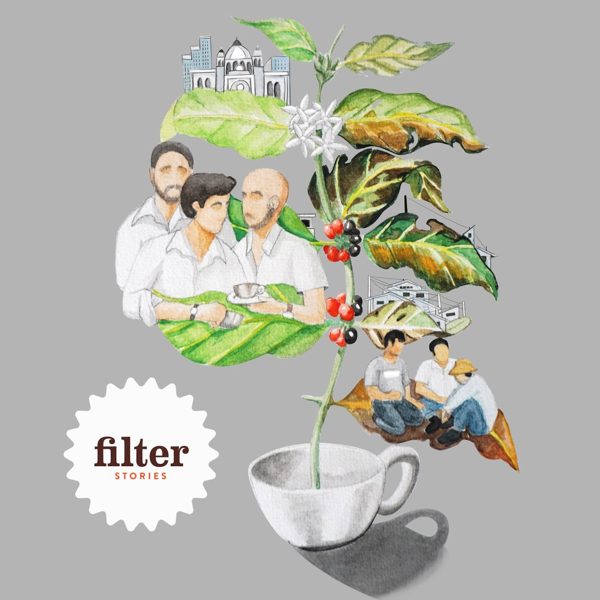
Over five episodes, we explore stories of El Salvador. We confront massacres, wide inequalities and the specialty coffee you drink today.
Buried deep in this story is a group of people our coffee dollars are neglecting across the world. People who decide to migrate north.
Piano music composed and performed by James Harper
Sound mixing: Dom Edgley / http://www.domedgleysound.com/
Filter Stories logo design: http://www.headquarters.studio/
A big thanks to: Cesar Magana, Mauricio Escalón, Álvaro Castro, Emilio Lopez Diaz, Marco Ariz, Francescopaolo Marolla, Walter Retana, United Nations Food and Agricultural Organisation El Salvador, Rony Cordero, Cafe Salkantay Santa Ana, Jodie Cárcamo, Manuel Jesus Lopez, David Velasquez, Gilberto Baraona, Hugo Hernandez, Sara Cortez, Consejo Salvadoreño de Cafe, Tyler Wright, Josh Fontecha, Robert Durrette, Farmers First Coffee, Mauricio Benjamin Bautista Arucha, Israel Márquez, San Carlos Dos Cooperative, Sixto Ramos, Policar Siciliano, Helena Merivel Dias de Jimenez, Olga Carmel Ramirez, Azules Piedras Cooperative, Luis Ortez Ordoñez, Roberto Figero, Jesus Salvador Ortez, Victor Flores, Bronwen Serna
Editorial thanks: Hannah Smith, Tina Ghelani, Adam Harper, Raymond Detweiler, Melanie Böhme, Andrew Johnson, Karin Vališová, Jesse Hartman, Matthias Staeheli
The British Ambassador’s wife was acted by Heather Simons
Read the transcript
James Harper
So, the other day, something terrible happened.
I mean, it's something we all have to go through at least once in our lives.
Yep, I ran out of coffee.
So, I did what I think most of us do.
We walk down to our local cafes, some of us maybe even run, and we look for some roasted coffee to take home.
And on the walls, we see these beautifully packaged bags of roasted coffee.
This one's crimson red, that one's pastel blue.
There's so many of them, I often don't even know what to choose.
So, I often ask the barista for their favourites.
Then you pay for it.
Okay, cheers.
You take it home, pour the beans into the grinder, grind it, get your hot water, brew it, pour it into your cup, and finally you sit down and you can enjoy it.
Let's see, let's see.
Flavour notes.
Sweet chocolate, molasses, hibiscus, plums and berries, creamy body.
Let's see whether I get any of those.
Oh wow, molasses.
Plums, berries.
Yeah, it's like a Christmas pudding.
It's really good.
And then you might get your phone out, open the news, and then you see this.
Now, us buying that coffee from El Salvador and Trump talking about a border wall, totally unrelated.
Or are they?
Over the next five episodes, I'm going to show how your decision to buy a Salvadoran coffee is connected to the border wall.
And it's going to be a big story because it's a story of El Salvador, the country.
A country of 6 million people in this rectangular box about the size of Israel or New Jersey.
It's a story of power, massacres, wide inequality, and how it threads with your family history.
Well, insofar as what coffees your parents, grandparents, and great-grandparents drank.
And it's also a story about how our actions today affect the border wall.
And at the end of it all, we're going to get back to that cafe and look at those bags of coffee one more time.
Should we still choose a Salvadoran coffee?
I think so, but it depends who it's from.
And not just from El Salvador, but across the world.
I'm James Harper, and this is Filter Stories.
The untold stories hidden in your cup of coffee.
In this first episode, I'm going to present two stories about the origins of coffee in El Salvador.
We're looking at 1850s to the 1930s.
The facts are the same, but the stories are very different.
So picture your great-grandmother sitting down and enjoying a cup of coffee.
Imagine she was curious to know where her coffee came from, and maybe who in El Salvador grew it.
This first story will be most likely the story your great-grandmother would have been told.
Hello?
Mauricio Escalón
Hello, I'm here.
Okay.
I'm at El Molino.
Yes, yes, yes.
Okay, great.
All right.
Thank you very much, guys.
James Harper
So I'm in the west of El Salvador, in a car being dropped off at a colonial-era hacienda.
Think wooden columns tiled roofs.
I'm here to meet this man.
Mauricio Escalón
Nice to meet you.
Nice to meet you.
His name is Mauricio Escalon.
Until next time.
Yes, thank you for everything.
James Harper
I haul my bags out of the car, and Mauricio leads me into one of the rooms that all face the courtyard.
Mauricio Escalón
Here is our office.
Mauricio Escalón
This used to be the old mill.
Yeah, let's say the volume mill.
James Harper
In the middle of this room hangs this big oil painting.
So this is a picture of a man sporting a 19th-century mustache, very large white mustache, and a lot of fabric, a lot of ties and fabric.
Was he your great-great-great-granddad?
Yes, yes.
Mauricio Escalón
He was my great-great-great-great-grandfather.
I'm the fifth generation, yeah?
James Harper
We guys look identical.
Mauricio Escalón
Huh?
James Harper
Really?
I think he's identical.
So let's turn back the hands of time, like way back to 1850s El Salvador.
In the 1850s, El Salvador is all about agriculture.
It makes a lot of its money growing and exporting indigo, a plant that's used to make blue dye for fabrics.
And El Salvador back then is idyllic.
British Ambassador's Wife, 1850s
The environs of the city are very beautiful, being one mass of luxuriant orange and mango trees, bending beneath their load of fruit.
James Harper
I found the memoirs of the wife of the British ambassador in the 1850s, and this is how she described the capital, San Salvador.
British Ambassador's Wife, 1850s
And the cottages of the poor people are remarkably neat and clean, each surrounded by its own beautiful shrubbery of fruit trees.
James Harper
Now, Pedro José, Mauricio's great-great-great-great-grandfather, owns a fair amount of land.
But he and the other wealthier landowners have a problem.
Synthetic blue dye has been invented.
The indigo plant's days are numbered.
But fortunately, coffee has arrived on the scene.
And in the 1860s, Mr. Pedro José gets in on the action.
Mauricio Escalón
And in 1860, 1865, he started to do some of the pulping experiments about coffee and everything.
James Harper
And Pedro José is quite the jet-setter by 1860 standards.
Mauricio Escalón
Because he lived a lot of time in San Francisco, yeah?
Mauricio Escalón
Six months in San Francisco, six months here.
James Harper
Mr. Pedro José knows the way to make money in coffee is to export it.
And fortunately, he's in the right place to find a buyer.
Mauricio Escalón
And he had very good connections with people in San Francisco.
So they started with this Folger family, yeah?
To talk about the export of coffee.
So we can say they did the first exports from El Salvador to the United States, yeah?
James Harper
To Folgers, no less.
Mauricio Escalón
Yeah, Folgers companies.
It's still in the market, yeah?
James Harper
But this is huge.
This goes back to Folgers is one of the largest roasters in America.
Yes, yes, yes.
Mauricio Escalón
That is how he started, yeah?
Having the confidence with this Folger, Mr. Folger.
James Harper
So coffee exports start growing fast.
And El Salvador's politicians want to change the image of their country.
They want capitalists to take a risk and help the country build roads, a banking sector, industry.
And one thing El Salvador has is fantastic agricultural land.
Mauricio Escalón
Like the government at that time started to give land to people to start growing coffee, yeah?
El Salvador had all this land that wasn't being used productively.
It started to grow coffee, yeah?
Because there was nothing at the time.
James Harper
And this is great news for the peasants of El Salvador.
Mauricio Escalón
And they have something that is, I would say, that is much better than probably food and clothes.
They have work, yeah?
James Harper
There's so much money to be made.
Lots of different people get in on the action.
Mauricio Escalón
And then a lot of companies, people started to do the same, yeah?
And there were like very big, big companies, yeah?
James Harper
But then these capitalists encounter a new problem.
Communism arrives in the 1920s.
The peasants are lapping it up and they try and start a revolution.
Mauricio Escalón
And in 1932, there was a revolution.
And El Salco is one of the emblematic cities in El Salvador because we say that communists were stopped there.
And I can say because my grand-grandfather from my mom's side was a military in that time.
So we had a history about that also.
James Harper
After the government takes back control, the country continues to prosper economically.
And the capitalists who took the risk in the first place start amassing a lot of wealth.
James Harper
Wow, I mean, this is...
Can we just pause for a second and look at where we are?
This is like old world luxury.
Mauricio Escalón
Yeah, yeah, yeah.
Look, this house is from 1760, yeah?
James Harper
And you can feel this wealth just standing in the courtyard of Mauricio's Hacienda.
James Harper
And here we have an animal with some antlers mounted on the wall.
What animal is that?
Mauricio Escalón
He's my dad.
James Harper
Mauricio's dad starts up the engine of the vintage Mini Cooper sitting in the driveway.
This is the only vintage car I've ever seen in Central America during my travels.
Mauricio Escalón
We love English cars, yeah?
James Harper
If our great-grandmother asked where her coffees came from in El Salvador, she might have been told that the coffee was a product of the hard work from these capitalist pioneers like Pedro Jose.
He is opening El Salvador to the world, bringing the country into the modern age.
And if he makes money while doing it, well, that's his reward.
Mauricio Escalón
I am not ashamed of what we have done.
A lot of people in the world, I will say, if I have a Rolex, if I have a Land Rover, if I have a Mini Cooper, it's because we have worked for that, yeah?
And we like to do it, yeah?
And we are proud.
James Harper
Mauricio's dad steps on the gas and takes the Mini Cooper for an evening spin.
Okay, so that was the first story.
Now, let's rewind the hands of time again and get back to 1850s El Salvador.
To understand the second story, we need to know more about who lived in El Salvador back in the 1850s.
And lucky for us, the wife of the British ambassador wrote a lot about that.
She mentions the wealthy classes like Mauricio's great-great-great-great-grandfather, Pedro Jose.
She also talks about indigenous Salvadorans.
British Ambassador's Wife, 1850s
Many of the most fertile lands in the country belong to the Indian communities.
James Harper
These indigenous Salvadorans farm a lot of this fertile ancestral land communally.
The third and final group she mentions are the mestizos.
They are the half-bloods, a mixture of European peasants who left Europe in search of a better life and they mingled with indigenous Salvadorans.
And her most important observation of all is that El Salvador is relatively equal.
British Ambassador's Wife, 1850s
What most strikes one on arriving from Europe is the absence of all extreme poverty.
The eye is not offended, as it is in the south of Europe, by swarms of loathsome objects afflicted with every disease under the sun.
Nor do you see the gaunt forms and starving faces that meet you too often in every town in England.
James Harper
So how does this all change once coffee arrives on the scene?
To answer that question, we're meeting this man.
Álvaro Castro
Okay, yeah.
My name is Alvaro Castro and I'm an economist.
I have always worked in banks and, you know, being part of the, just being a little cog in this big capitalist machine.
He also knows a thing or two about coffee.
James Harper
I'm also the son of a coffee grower.
Alvaro and I have just pulled up outside a private members club.
We're up on this mountain, the city spreading out below us.
Alvaro leads me down these hallways of this private members club and we end up in a conference room.
The TV is blaring professional wrestling.
Álvaro Castro
Alvaro loves this stuff.
You have to watch like one full show and then you'll see the light.
James Harper
It's like, thank God I have a microphone in my hand.
So I tell them to turn it off.
We sit down and get into the story.
So El Salvador, 1850s, not too equal, but not too unequal either.
And there's not very much coffee in the country.
And then things change.
Álvaro Castro
So what happened and peasants, you know, natives, they had communal lands that they grew their food on and it was all managed in a communal way.
So the government, what they did is that they found out that in order to boost the development of the country, they decided to take all this communal land from the indigenous people and they gave it to the upper classes who had the capital to work it.
James Harper
So a small group of wealthy landowning families begin to plant lots and lots of coffee.
And coffee explodes.
In the 1860s, coffee is just 2% of El Salvador's exports.
But by 1926, it's 95%.
Meanwhile, the government passes vagrancy laws in 1881.
It's now compulsory for Salvadorans to work wherever they can find work.
And indigenous Salvadorans who are quickly losing their communal land are being driven to work on the growing coffee plantations owned by a few wealthy families.
I asked Salvador, what would it have been like working on one of these coffee plantations?
Álvaro Castro
So can you imagine you being a peasant?
You cannot read and write.
You have seven children.
They don't go to school.
They're just waiting for them to be, what, 12 years old to work full-time on the farm.
And if you're of indigenous origin, the more indigenous you were, the more rejected you were.
You were closer to an animal.
James Harper
Add to this food shortages.
El Salvador's population is growing quickly.
Between the 1850s and 1930s, in about 70 years, the population more than triples.
And El Salvador has super fertile volcanic soil.
But so much is being used to grow coffee, the country begins importing food.
Food prices rise.
And by the 1920s, peasant workers are going hungry.
The communist political party hijacks this frustration and helps persuade peasant workers to strike.
And in 1932, it all comes to a head.
Thousands of peasants, mostly indigenous Salvadorans, attack plantations in the West.
They fight with mostly what they have to hand, machetes.
And the estimates suggest they murder between 20 to 50 people.
And unfortunately for these peasants, months before this attack, El Salvador's democratic government is overthrown by the military.
To learn how this military government responds, I travelled to Izalco, one of the beating hearts of this rebellion.
I meet the town's archivist, Mauricio.
We walk through the town square into this quiet park, and at the end of it lies this memorial to El Salvador's bloodiest massacre.
James Harper
We have like a large, maybe it's a two, three meter high kind of mound of rocks and a small plaque.
James Harper
A local schoolgirl accompanying the archivist reads out the plaque.
Military government forces swept the region, taking back control from the indigenous peasants.
They then began their revenge.
James Harper
Can you please describe how they were killed?
James Harper
Mauricio, the archivist, points to the ground.
Here, indigenous peasants were rounded up, then given shovels and picks, and they dug a deep hole.
Then they were shot.
And then, in the town of Dolores, nearly 3,000 indigenous peasants were led to believe that they would be safe from the killings at the local church.
In front of the atrium, the military hid a machine gun.
They unveiled it, then opened fire.
The body count included the elderly and children.
James Harper
And what was the result?
James Harper
From Mauricio's point of view, this was an extermination.
Estimates of the dead range from 10 to 40,000 people.
Most of them murdered in the first 72 hours.
Here is Alvaro, the economist again.
Álvaro Castro
And after the slaughter of 1932, a lot of people just, well, they changed their indigenous names to more, to Spanish sounding last names in order not to be persecuted.
They stopped talking their dialects, Nahuatl being the major one.
James Harper
Where can you find indigenous culture in El Salvador today?
Álvaro Castro
In a museum, in a book.
You can still see some elderly people that survived that massacre and that kept the language and some customs, but it's just a tiny little pebble.
James Harper
In a later episode, we'll connect how indigenous Salvadorans losing a connection to their land and culture can be tied to Trump's border wall.
Now, what does all of this have to do with coffee?
To me, it seems like this unequal society that led to the massacre was fueled by coffee profits.
These profits went into the hands of a minority of wealthy families.
It didn't go to help peasant Salvadorans to progress upwards economically.
I throw this theory to our economist, Alvaro.
And is it a stretch to say the slaughter happened because of coffee?
Álvaro Castro
You know, when you contacted me, you mentioned something like that.
And I had never seen it that way, but it got me thinking coffee was a big driver.
It was not the only one, but it was the main pillar of the economy.
So you cannot take it out of the equation.
So yes, a lot of people were murdered because of a cup of coffee.
You can put it that way.
James Harper
We've just heard two very different stories about the history of coffee in El Salvador.
However you want to see this story, capitalism against communism, a small number of Caucasian families exploiting indigenous people and land, the fact is, from the 1930s onwards, coffee profits continue to flow into the hands of a small number of wealthy families.
And coffee at this point is growing as an industry?
Yeah, yeah, yes.
Álvaro Castro
Coffee is the grano de oro.
James Harper
This is Alvaro, our economist again.
Just translate that for my listeners.
Álvaro Castro
Grano de oro, which is the golden bean.
James Harper
Like the goose that lays the golden eggs.
Yeah, pretty much.
Yeah, pretty much.
So the 50s to the 70s are a golden period for these wealthy families.
The profits from coffee help these families get into other sectors of the Salvadoran economy.
The military government keeps the status quo and poorer Salvadorans struggle to progress upwards economically.
The privileged families.
Álvaro Castro
Institutions were created in order to boost economic development and industry, but all the true rewards, they always went to the wealthy ones.
And some of the crumbs were given here and there.
And then you have this huge mass of people that were oppressed in the sense of lacking opportunities to progress.
British Ambassador's Wife, 1850s
Your coffee is delicious.
Do you know something I don't know?
Álvaro Castro
It's Folger's flaked coffee, flaked to release lots of rich flavor.
James Harper
By the 1970s, the tiny little country of El Salvador is the fourth largest coffee producer in the world.
British Ambassador's Wife, 1850s
Delicious coffee, Mrs. Olsen.
Oh, thanks.
It's Folger's flaked coffee.
James Harper
Now here's the thought.
When your parents and grandparents enjoyed their morning coffees, they unknowingly sent their money into El Salvador's unequal economic system.
Álvaro Castro
You only need four of Folger's flaked coffee.
James Harper
And who would have thought that their coffee dollars would help create one of the bloodiest civil wars in the 20th century?
Álvaro Castro
Delicious.
Do you know something I don't know?
British Ambassador's Wife, 1850s
Delicious Folger's flaked coffee, flaked to release Folger's rich flavor in automatic drip coffee makers.
James Harper
Our economist Alvaro has a nickname for his own country.
Álvaro Castro
This country, I told before that I call it El Savage.
And it sounds funny, but it's a savage country when you have so much inequality.
James Harper
In the next episode, we'll explore how this inequality killed 75,000 people in the 1980s, and how that set the stage for a giant wave of migration into the USA.
Thank you for listening.
Every week, I'm going to release a new part to this series.
There's five in total.
Now the other four are very close to being finished.
And for everybody who participated in the Indiegogo campaign, which is still open, I'm going to send a link with the other four episodes as soon as they're ready.
So if you want to hear the rest of the series sooner rather than later, join the Filter Stories Indiegogo campaign.
Maria's Coffee could make a great Christmas present.
There's a link to the campaign in the episode description.
Also, a quick word before I go.
If you really like what you heard, please tell your friends about it.
Word of mouth is one of the best and one of the very few ways for independent podcasters like me to get the word out.
So if you like what you heard, tell a friend.
This episode was soundmixed by Dom Enschli.
You can find more of his work at domenschlisound.com.
And the Filter Stories logo was created by Headquarters, a packaging and branding design team.
Find more of their work at headquarters.studio. Thanks so much.
Speak to you next time.
Listen on Apple Podcasts, Spotify, Pocket Casts or your favourite app.
More from Human Stories
See allBig and Small in El Salvador: Part 3
We meet a man who came from humble beginnings who has achieved what Armando and Maria have only ever dreamed about.
Big and Small in El Salvador: Part 2
Imagine you’re a coffee buyer on a mission to buy Salvadoran coffee. We visit Armando and Maria’s farms. Which farm would you choose to buy from?
Big and Small in El Salvador: Part 1
20 years ago specialty coffee patted itself on the back for saving coffee farmers, both big and small, from the misery of low coffee prices.