Show notes
20 years ago specialty coffee patted itself on the back for saving coffee farmers, both big and small, from the misery of low coffee prices.
But what's it like for a small coffee farmer getting into this specialty coffee club today?
We dive into El Salvador’s Cup of Excellence to contrast the experience of two producers.
Piano music composed and performed by James Harper
More episode information here: www.medium.com/@FilterStories
Sound mixing: Dom Edgley / www.domedgleysound.com/
Filter Stories logo: www.headquarters.studio/
A big thanks to: Maria Zoila Pineda de Rivera, Oscar Rivera, Marco Ariz, Ignacio Gutiérrez
Editorial thanks: Janina Grabs, Jenn Rugolo, Tina Ghelani, Adam Harper
Maria was acted by Ana Kavalis
Read the transcript
James Harper
I'm sat in a hotel conference room, surrounded by coffee farmers in cowboy hats and government officials in white shirts.
Now, let's play a little game.
What national anthem is this?
Up on stage, they're about to announce the winners of El Salvador's 2019 Cup of Excellence.
This competition decides which coffee farmer grew the tastiest coffee in El Salvador this year.
After some boring speeches, we get into the awards.
Different coffee producers walk up to collect their awards.
What strikes me is how different they look.
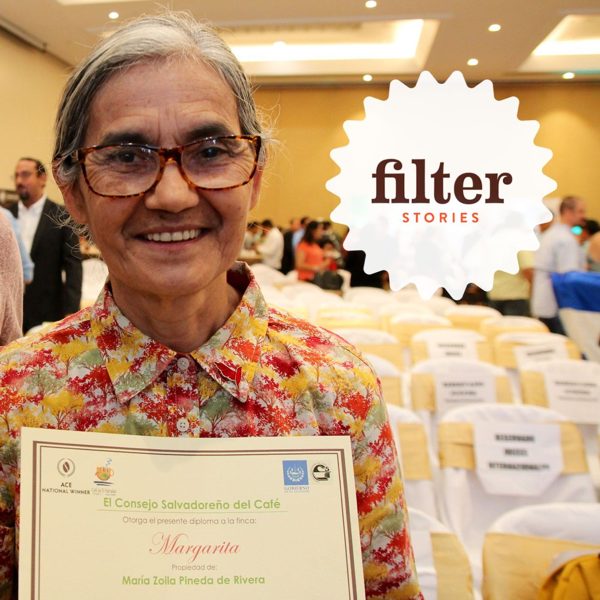
For example, right now, a woman in her 60s is walking by a row of chairs.
She's not wearing any jewelry, nor makeup.
And then, by the time we get to the top 10, the coffee producers look more and more like this man in his 50s.
And as it turns out, this same man gets up twice to collect two awards.
The ceremony is over, the marimba band starts up, and the room swirls with coffee producers and coffee buyers shaking hands.
This competition is symbolic of specialty coffee.
It's this idea that if a coffee producer makes great tasting coffee, we'll reward that by paying higher prices.
Placing in this competition opens the doors for unknown coffee producers to meet buyers, the people who can pay them badly needed, financially sustainable prices for their higher quality coffees.
But I can't shake the suspicion that there's a deeper story at play.
20 years ago, specialty coffee patted itself on the back for having this humanitarian focus.
The fact that this rising tide of higher prices were lifting all boats, all coffee producers of all sizes.
But how does that square with what we just saw?
The man in his 50s got up to collect two awards, both in the top 10, while the older woman's coffee was only the 28th best on the table.
I introduced myself to the man.
Let's nickname him Armando.
He hands me his business card.
I then introduce myself to the older woman.
James Harper
Her name is Maria, her actual name.
She gives me her phone number.
James Harper
In this and the next episode, we're diving deeper into Armando and Maria's lives and farms.
The fact they're here in this hotel conference room means your fancy coffee tomorrow morning is more likely going to be one of theirs.
But what did it actually take for them to get here in the first place?
I'm James Harper, and this is Filter Stories, the untold stories hidden in...
I'm on an American-style school bus.
It's hot.
I feel sweat trickling down my back.
The bus is taking me two hours north, up into the mountains near the border with Honduras.
I hop off at a little town called La Palma.
The air is cool, and I feel like I'm walking into a rainbow.
The town's walls pop with multi-coloured paintings of birds and armadillos.
Trucks with Honduran license plates lug shipping containers.
Their black diesel fumes tickle the painted butterflies.
I find a place to stay, and then as the sun sets, I stroll through town and meet Maria.
We wander into a local restaurant.
Maria hands me a gift, a bunch of tree-ripened bananas.
They're syrupy sweet.
The microphone's rolling, and we're about to dive into Maria's world and explore what kind of life she's lived.
And because Maria only speaks Spanish, you're going to hear an actor, and a lot of really, really terrible Spanish from me.
I ask Maria, where were you born?
Maria Zoila Pineda
Here in La Palma.
But then after, I went to live close by, like 12 kilometres.
And then when I was 14, my father died.
When my father died, I had to go to San Salvador.
I worked during the day and studied at night.
And then, like that, I kept going, going, till suddenly I found a way to study in a normal school.
I got a loan so I could stop working.
They gave me the money, and I went to study at a normal school, and then I graduated.
After I graduated, I worked in a local school as a teacher.
I paid the loan back.
I worked 34 years.
James Harper
While training to be a teacher, Maria met her husband, Oscar.
They taught side-by-side in the same school.
They had a couple of kids, too.
And by the time the kids got to university, Maria and Oscar were living together, working together and hoping to retire together.
They also had a small, two-and-a-half hectare coffee farm.
Maria inherited it from her father, and Oscar looked after it.
James Harper
He brought the fertilizer, doing what needed to be done.
James Harper
But six years ago, Maria's life was turned upside down.
Maria Zoila Pineda
I don't know.
It was a normal morning.
He woke up, went to school before me.
At 9 a.m., he came back home.
At recess, I came back, too.
When I found him, he'd had a stroke.
He had collapsed, dying.
We called the ambulance, the doctors, but no.
He died.
Oh, terrible.
It was a difficult moment.
James Harper
The first year was horrible for me.
Maria Zoila Pineda
At home, we lived together, only me and him.
And now I am alone.
James Harper
Maria took early retirement and began living on her $15-a-day pension.
She was now well into her 50s, and then decided to devote most of her time to the coffee farm.
I asked why.
James Harper
There are many reasons.
Maria Zoila Pineda
First, if you don't work the coffee farm, you can't give work to the people.
James Harper
I don't get much of a pension, but I have enough to eat.
Maria Zoila Pineda
So whatever I earn from the farm, I invest back into the farm.
Also, the shade trees are avocado trees.
Now the avocados are ripe.
This is food, not just for me, but for many, many others.
Normally, we would pick something like 10,000 avocados.
James Harper
OK, let's press pause on Maria's story so we can explore Ammanos.
I'm back in San Salvador, the capital.
Armando suggested we meet at a Taco Bell at 10am.
It's a 15-minute walk from my hostel.
San Salvador, one of the most dangerous cities in the world, and I'm just walking around.
It's been four minutes, I've seen three pistols and two shotguns.
Contrary to popular belief, for tourists, El Salvador is actually pretty OK.
If you're a local and you're young, especially, then the gangs can be a real problem for you.
But if you're a tourist and you know where to go, people say it's actually safer than Costa Rica.
Here we are, outside Taco Bell.
James Harper
I walk inside, order a coffee, and then I sit down and wait.
James Harper
And wait.
And wait.
Armando walks in around 10.15. That was too much?
Armando
Yeah, way too much.
Huh?
Way too much.
Will that affect?
Yes?
Yeah, we'll have to go somewhere else.
OK, let me know.
James Harper
Armando leads me to Taco Bell's offices.
All right, we're going around the corner.
It's a little office, interesting.
My shotgun microphone is ready, and we dive into it.
Armando
Just to introduce myself, I'm a fourth-generation coffee producer, farmer, and a coffee producer.
Armando
Coffee exporter.
My family has been in doing this business of growing coffee and exporting for more than 130 years.
James Harper
How much did your family have in 1979?
Armando
Oh yeah, we were, to give you an idea, my family was exporting around between 15,000 and 20,000 bags per year.
That's a lot of coffee.
I used to employ around 500 people monthly.
James Harper
Now, Armando's life was turned upside down.
In the 1980s, when El Salvador descended into a civil war.
Armando
The hardest hit area of the war was my area.
We lost everything in one day.
James Harper
Did you get back the farms that you had before?
Armando
No, no, no, no.
I only was able to keep one farm.
Armando escaped the violence by doing his undergrad in America.
In Dallas, Texas, a school called SMU.
Yeah, I got my degree in economics and finance, and I was doing the war.
James Harper
When Armando returns to El Salvador, he decides to run the family's remaining 150-hectare farm.
You know, the one the guerrillas didn't take.
And he gets involved in the coffee milling business.
Basically, husking coffee out of its parchment shell so you can export it.
Armando
I was in charge of El Salvador and Guatemala, 2,000 people, and six mills, and exporting coffee.
He also gets involved in the franchise business across Central America.
I used to own Blockbuster.
I used to own Subway.
I used to own Domino's Pizza.
Armando has always enjoyed coffee and business.
I mean, basically, at the end, I'm a businessman.
I mean, there's nothing more grateful in the world that, you know, do what you want to do and make money out of it.
James Harper
But in the early 2000s, Armando is in trouble.
He's growing and milling commodity coffee, but the coffee market has crashed to unbearably low prices.
But he is in luck.
Because specialty coffee is just taking off.
And Armando sees he will get better and better prices if he can offer coffees that are…
Armando
Extremely good quality.
You know what I say?
Just quality.
It's extremely good quality.
You know, coffees that are really rare.
Coffees that are really hard to get.
Coffees that not too many people have.
But to get there, Armando needs to invest a lot of money.
I broke my piggy bank.
So really, I had to take a decision.
If I want to be a coffee farmer or a coffee exporter, you know, I have to put all the meat in the grill.
And basically, I sold some properties, you know, urban properties, in order to raise money.
And also with the help of a local bank, I was able to, you know, build what I have built in the past years.
And before long, Armando starts growing coffees that are tasty enough to enter into the Cup of Excellence.
Basically, one of the things that really have helped me, number one, Cup of Excellence.
You know, it really launched me.
It was my first, like, discovery.
Like when you discover this movie star and she's working, you know, in a restaurant.
And then the Beyoncé, you know, she's working there as a waitress.
And then suddenly, this guy spots him and then, you know, it goes to a show and then she becomes famous.
So Cup of Excellence is really the place to spotlight yourself.
James Harper
And through the Cup of Excellence, Armando meets influential figures in the specialty coffee world.
Which is one of the, it was a World Barista Champion.
With these connections and the bigger premiums he's now earning, Armando invests more into his farm to create even more interesting flavors.
He experiments with different coffee varieties and different fermentation techniques.
But funnily enough, his best coffee at the Cup of Excellence this year was an ordinary coffee, processed in an ordinary way.
Armando
You know, I competed with a washed bourbon that is like, I tell people it's like I went to a competition to this universe with a girl without any paint on her face.
I mean, no makeup.
James Harper
The majority of Armando's coffees are now earning multiples above the commodity price.
And he is in an extraordinary position as a coffee producer.
Armando
I'm basically pre-sold.
I'm sold for the year.
People ask for coffee, I can't offer anymore.
I'm sold out.
James Harper
And despite being sold out and having found his buyers, he still competes at the Cup of Excellence every year.
Armando
So 20% of the coffee that was in the competition last year was from my farm.
This year, because they didn't like, you know, people winning too much, which I think, you know, is something that I was going to put 12.
This year, I only put two.
And of those two, which is the most allowed per producer this year.
This year, the rules were changed.
James Harper
The Cup of Excellence changed the rules to try and level the playing field a little bit.
Why do you continue competing?
I mean, you have your buyers, you have your market.
Why bother?
Armando
That's an excellent question.
These people have told me, you know, why are you still competing?
And you should give more space to other people.
You know, I mean, you already have your wings to fly.
Why do you need them?
Armando offers variations of the same explanation.
At the end of the day, it's what coffee buyers want.
People say, OK, we want to buy coffee from El Salvador.
Who are the top guys?
Ah, OK, these are the top guys.
They're one, two, three, or four.
You know that.
Why?
Because they're the exporters.
Why?
Because they're the ones on World Cup of Excellence.
Why?
Because they have a name.
James Harper
Armando is trying to do what's best for his business, and he's using every tool he can to differentiate himself from the millions of coffee producers that coffee buyers have to pick and choose from.
Now, what's interesting is that some of the tools that Armando uses to get ahead, hard work, a Western education, deeper financial pockets, they're not unique to him.
He and a few others are part of a historically wealthy land-owning elite.
By the 1970s, they sat at the top of a very unequal society that collapsed into civil war in the 80s.
Tens of thousands were killed, and many farms were taken from the elite and given to poorer Salvadorans.
In a later episode, we'll explore this and what coffee looks like today in El Salvador.
Back to Armando.
I want to experience what it's like being a coffee buyer visiting his farm.
Are you going to the farm?
Yeah, right now.
Armando
Oh, really?
Oh, wow.
And my timing is perfect.
If you want to spend some time with me, I mean, we're leaving to the farm at 1 p.m. This is the beast.
James Harper
This is a new Ford Ranger.
We're cruising down the highways.
Armando
Anything to drink?
Okay, thank you.
We're going to get a beer.
James Harper
We stop at a gas station for beer.
Armando plays his favorite music.
We'll visit Armando's farm in part two.
For now, let's head back to La Palma and catch up with Maria.
James Harper
So my one worker does a huge amount of work.
And he's the worst paid.
Maria Zoila Pineda
So I am looking for a place where they could pay more for my coffee so I can pay a little bit more to the people who help me on the farm.
James Harper
We've seen how Armando figured out how to create a financially sustainable coffee business in an era of low, low prices.
Let's explore Maria's reality trying to do the same for her little coffee farm.
After Maria becomes a widow, the commodity price for coffee gets lower and lower.
Maria Zoila Pineda
Me, after my husband died, I was selling my coffee in the cooperative.
And the price was okay, you know.
It covered the farm's expenses.
James Harper
Fast forwarding three years, she's struggling to even cover her costs.
Maria Zoila Pineda
Three years ago, I brought my coffee to them to sell.
They wanted to pay for my Pacamara coffee, the same one in the Cup of Xmas.
They said they would give me a price.
Then after a few days, they told me, look, your coffee is not good.
We are going to pay less for it.
So I told them, no, I will take it back.
James Harper
So Maria sets out on a mission to prove that her coffee is good coffee, and it deserves a good price.
Now, from my perspective, the solution seems simple.
She just has to reach out to a coffee roaster in a rich country, just tell them her story, and then they could buy from her directly and give her much better prices.
I asked Maria whether she'd like that kind of relationship.
James Harper
Oh yeah, that would be great.
James Harper
And the place to find them is at a trade show.
I asked Maria, could you not travel to a trade show in America?
Maria Zoila Pineda
I asked, why weren't you at the last one?
So the thing is, I don't know when it is.
No one invites me.
I don't know what to do.
When, where, how, all that.
James Harper
I should have an invitation.
James Harper
For the record, Maria doesn't need an invitation.
So maybe Maria could get the attention of a roaster with a website.
I asked her whether she has one.
I asked whether she has internet.
Maria Zoila Pineda
No, but my son has it.
It's the same.
James Harper
Maria's son does help, but he lives two and a half hours away and has a full-time job.
The restaurant is closing.
They're kicking us out.
James Harper
I settled the bill.
James Harper
And we head down the road to Maria's house.
Now, while Maria would struggle to reach a wealthy roaster, she did everything she was able to from her little town.
So Maria needs much more than the cooperative is paying.
A dollar a pound.
Today's commodity price, totally financially unsustainable.
She needs something closer to two dollars a pound just to cover costs.
But she needs even more than that to thrive in the world of specialty coffee.
She found a specialty coffee middleman for some of her coffees.
They most recently paid a dollar fifty.
She also entered a regional competition, came in the top 10 and got paid $2.75. But it was a one-off and a small amount of coffee.
Maria jumps out of her chair and pulls out the top drawer from a heavy wooden chest of drawers.
She rummages through some papers.
Maria had heard that the government could provide detailed flavor information for her coffees.
If her coffee was good enough, she could enter them into the Cup of Excellence.
It was a long shot and not a cheap process.
And the results were exceptional.
Maria's coffee was good.
So good, in fact, if she submitted it to the Cup of Excellence, it might be one of the best in the country.
And the rest is history.
Her coffee this year was a national winner.
Our interview is winding up and I ask her whether there's anything else you'd like to say.
James Harper
Well, if I can speak freely, I would like to say that I am a daughter of God, that I am made of clay, that I love the earth, and that I love coffee.
Maria Zoila Pineda
I am a daughter of God.
I'm made of mud.
I love the earth.
And to offer your best self is good.
James Harper
On the white walls of this room, I count a dozen holy eyeballs staring down at us.
Maria takes me on a little tour of the house and we stop in her study.
Maria Zoila Pineda
When I can't work on the farm, then I paint.
James Harper
Maria picks up a chest-sized canvas bursting with bright colors.
James Harper
So we have a scene, we have a beautiful colorful scene of mountains and people, chickens, villages and coffee farms and all sorts of fruit trees.
James Harper
This is a similar style of art that covers the walls of her town.
The paintings she's sold over the years helped her buy this house.
James Harper
Life is pretty, it's colorful, it's beautiful.
Maria Zoila Pineda
And that should be expressed in color.
James Harper
I finally leave Maria's house.
As I walk back to my hotel, I reflect back on Maria's journey.
The barriers to entry for her have been much higher than they were for Armando.
We need to visit their farms to truly appreciate how big a head start Armando had over Maria getting into this little specialty coffee club that offers financially sustainable prices.
In the next episode, we're going to pretend we're coffee buyers and we're on a mission to buy Salvadoran specialty coffee.
Whose farm would you choose?
Thank you for listening.
So, as I mentioned in the beginning, I've just launched an Indiegogo crowdfund.
This is a chance for us to taste Maria's award-winning coffee at this year's Cup of Excellence.
It's got flavor notes of white wine and pineapple.
I want to use whatever platform we have here to promote Maria's coffee in this very competitive world of specialty coffee.
And the publicity might help her find a long-term buyer who can pay financially sustainable prices.
So this is how it works.
Go to indiegogo.com and type in filter stories.
Or follow the link in the episode description.
Choose how much coffee you want to buy.
One bag up to four bags.
Once we've raised a thousand euros, I will buy a 69 kilo bag of Maria's coffee and transport it to Oslo.
There, it will be roasted by my friend Taylor Brown, we'll put it into beautiful coffee packages, and you'll get your coffees in time for Christmas.
If there's any money left over, it'll help cover the costs of making filter stories in the future.
The Indiegogo campaign starts now and will end on the 10th of September.
Thank you for your support.
The sounds you heard in this episode were professionally mixed by Dom Edgley, a Berlin-based sound engineer.
You can find more of his work at domedgleysound.com.
And the Filter Stories logo was designed by Headquarters, a branding and packaging design team.
You can find more of their work at headquarters.studio. Okay, until next time.
Listen on Apple Podcasts, Spotify, Pocket Casts or your favourite app.
More from Human Stories
See allUnseen Bean: Part 2
We investigate why by putting ourselves in Gerry's shoes and experiencing the coffee world as a blind man.
Unseen Bean: Part 1
Gerry has a disability that keeps 2 in 3 adults out of full time work.
Venezuela
What do you do when you want to buy a cafe but your country is collapsing around you?