Show notes
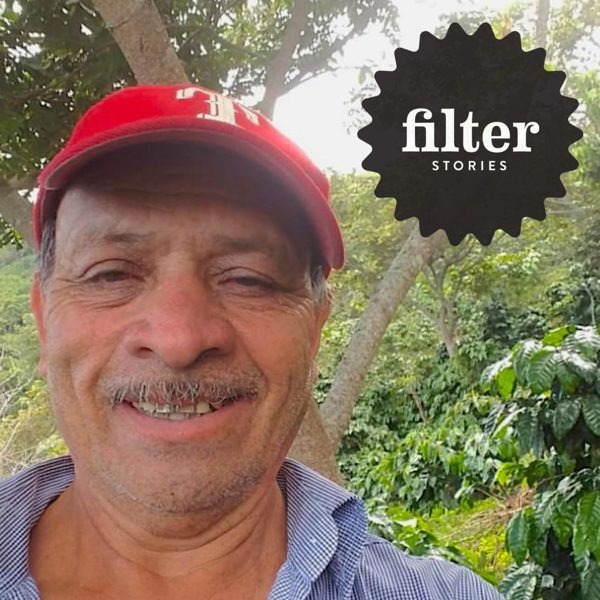
We meet a man who came from humble beginnings who has achieved what Armando and Maria have only ever dreamed about.
See the Filter Stories live show in Berlin on the 1st and 4th of October 2019: https://www.facebook.com/events/494233377792673/
Piano music composed and performed by James Harper
More episode information here: www.medium.com/@FilterStories
Sound mixing: Dom Edgley / www.domedgleysound.com/
Filter Stories logo design: www.headquarters.studio/
A big thanks to: Ignacio Gutiérrez, Maria Zoila Pineda de Rivera, Oscar Rivera, Marco Ariz, Hotel La Palma, Piero Cristiani
Editorial thanks: Hannah Smith, Tina Ghelani
Read the transcript
Armando
This is the farm with the most awards worldwide to now.
James Harper
So, I was in the cow without Armando driving through his coffee fields.
We were talking about the cup of excellence and the fact he's placed in the top 30 so many times.
But there was something still kind of hanging in the air, which is the fact that he's never actually come first.
But you've never come first place.
Never, almost this time.
Next time I will.
And this is kind of extraordinary because here's a man from one of the wealthiest families in El Salvador.
A university degree from Texas and coffee running in his family history for generations.
I heard of this other guy, this marginalized coffee producer in the same town where Maria lives.
This man from very humble beginnings has achieved something that Armando has only ever dreamed about.
This episode explores this man's story and reveals what a best case scenario looks like if you are a marginalized coffee producer and just how lucky you have to be.
I'm James Harper and this is Filter Stories, the untold stories hidden in your cup of coffee.
Okay, testing, testing, testing.
So it's morning on a bright day.
I closed the door of my $10 a night hotel and I walked down to find our man waiting for me in his pickup truck.
Ignacio starts up the car and we pull out of the driveway of the hotel.
As we cruise along the highway that weaves through the valley, Ignacio gives me the short story behind what happened when he entered the Cup of Excellence for the first time in 2011.
In 2011 he got first place.
In 2012 he had a small harvest so he didn't compete.
He competed again in 2013.
And he came first again.
The coffee auction smashed records.
In 2014 he didn't compete and in 2015 he competed again with the coffee from the farm that we're driving to.
And he came first again.
Who is this man who came out of nowhere to win the most competitive coffee competition in the country three times in a row?
And I'm also curious to know how this competition changed his life.
It's getting steeper and rockier.
We've turned off the highway and are now on the dirt roads that cut across the mountains.
The road ahead of us feels like it's vertical.
Some minutes later we arrive at a small ridge.
Here we go, this is the real deal.
I meet Ignacio's farm workers and a neighbor who speaks some English.
Ignacio's workers are holding barrels off a pickup truck near a bodega.
It's organic spray.
Ignacio shows me to the edge of the ridge.
James Harper
Wow, what a view.
James Harper
From here, La Palma, the town where Maria also lives, is just a clump of grey and brown Lego bricks deep in the valley.
So it's me, Ignacio and Manuel, you know the English-speaking neighbor, looking out over this view.
Three men, a microphone, on a coffee farm.
And maybe that's why, when I ask him whether he has any children, the conversation gets a bit laddy.
I then ask, well, how many women?
Four.
I ask him, well, do you have a partner right now?
The ice is broken, even though I feel a little uncomfortable about it.
And I move the conversation swiftly on.
And we get talking about his childhood.
In terms of formal education, he only ever did the first three months of the first year at school.
James Harper
I ask, why?
James Harper
Ignacio tells me he was born over there, as in over the mountains, in Honduras.
Ignacio grew up in Honduras until he was 10.
But shortly after he entered school, he got caught on the wrong side of the war between Honduras and El Salvador in 1969.
This is the famous football war that escalated while the two countries were playing each other during World Cup qualifiers.
It's kind of hard to believe that this man, with three months formal schooling, is able to produce coffees that Armando hasn't been able to, despite his university education in Texas and family money.
So let's explore Ignacio's journey in coffee.
I ask him when he started.
17.
About 40 years in coffee.
Ignacio is now in his late 50s.
But the thing is, his parents weren't in coffee.
They had cows and horses.
So for most of his life, he worked as a day laborer on other people's farms.
I ask Ignacio, how much were you earning before you won at the Cup of Excellence?
Ignacio earned the minimum wage, $7 a day.
And I wonder, how do you feed so many children on $7 a day?
So what happens is, when you have the minimum wage, you have a field, you grow the basics.
Corn, beans.
You have a cow for milk.
And $7 covers everything else.
James Harper
Clothes.
Shoes.
James Harper
The odd bit of medicine.
Now things started to change for Ignacio when he got his own farm.
His father passed away in the early 2000s, and he inherited a little bit of land.
It was five manzanas, which is about eight and a half acres.
He also inherited a horse.
James Harper
El Pepe.
James Harper
With this land, he slowly started planting coffee.
It took him four years to plant one manzana with coffee.
And things progressed like this, slowly, slowly.
And then, as he's telling the story, you know, we fast forward to 2011.
He puts his coffee for the first time to the Cup of Excellence, and he comes first place.
And his coffee, when it went to auction, fetched over $50,000.
Wow.
It's a big difference.
But things got really unbelievable in 2013, when his winning lot smashed auction records, even to this day.
His coffee went for $50 per pound.
The auction fetched over $90,000 for his 28 sacks of coffee.
And with this money, he bought the farm that we're standing in, and another car.
And this new farm got him first place in 2015, earning him tens of thousands of dollars for his 18 sacks of coffee.
And despite all of this, I still haven't figured out how he manages it.
And so I asked him directly.
He says, I think for starters, I had good coffee.
James Harper
And you need a little luck as well.
James Harper
And have faith.
Ignacio literally prayed to God.
A part of me feels like even Ignacio doesn't really know how he did it.
Because, you know, when it comes to growing coffee, the most important thing is exceptional land, as well as working it hard, having good employees, blah, blah, blah.
And this region around La Palma, where he and Maria have farms, you know, it's famous for the amazing flavors they produce.
So this is one of the really rare occasions where a coffee producer with little financial support or formal business education can have financially sustainable coffee farms by growing specialty coffee.
So Ignacio and Maria, to a certain extent, have kind of won the lottery by living in the right region.
Now I'm curious to know how Ignacio's life has changed.
One thing I notice is his shiny wristwatch.
He bought it a year ago.
And it cost him $100.
So he's probably not getting his hands dirty anymore.
He now employs people to work on his three farms.
Ignacio sells about a third of his coffees at very sustainable prices, $3 or more per pound.
The second third of his coffees, he sells for about what it costs to produce it.
And the last third, he loses money.
Now this might sound rough, but right now, most coffee growers sell all their coffees at below cost.
They are losing money completely.
Ignacio has also become a coffee buyer himself for a larger coffee company.
He earns about $10,000 in commissions.
I ask, like now, how much are you earning per day?
About $50,000 per year, a lot of which he invests back in the farm to grow it.
Ignacio's story is the best case scenario if you are a marginalized coffee producer in El Salvador.
But I know there are tens of thousands of marginalized coffee producers in El Salvador who will never be as lucky as Ignacio.
We wind up our interview and hop back in the car.
And as we're winding our way down, I realize I haven't figured out how the farm we just visited, the third farm he bought after the record-breaking auction in 2013, this is the same farm that gave him his win in 2015.
How did he manage to pick the right farm to buy?
As we bump down the rocky tracks, he drops his final clue.
He says, these people with these big farms, they get annoyed that I get first place all the time, despite being such a small coffee producer.
James Harper
And they ask me, how do you do it?
James Harper
And I say, well, you have to be fair in everything you do.
James Harper
Treat your employees well.
James Harper
We arrive back at the hotel, exchange a few phone numbers, and then I say goodbye.
So, thank you for listening.
I have three things I'd like to tell you.
First, the Indiegogo went amazingly.
We hit the stretch goal.
We sent a message to the coffee world.
We want to support marginalized coffee producers.
And it's still open.
I've extended it into October.
Every bean that you buy through this Indiegogo, Maria will get five times fair trade prices for it.
That's seven dollars per pound.
So, if you want to support Maria, support Filter Stories, jump on board, and taste her coffee.
There's a link in the episode description.
Second, I want to know what you think of Filter Stories and where to take the show.
Follow the SurveyMonkey link in the episode description.
It only takes 10 minutes.
And thirdly, I want to let you know about the Filter Stories live show.
This is a real-life enactment of the Firefly Story episode 2 at the Berlin Coffee Festival, in the wonderful Nano Café in Kreuzberg.
I'm performing it on the 1st and 4th of October.
So, it'll be like an interactive story.
Basically, it's going to be like me telling the story, narrating the story.
We'll hear snippets of Marie coming through.
There will be photos.
There will be a coffee tasting at the end, and beers, and maybe even live music.
I'm also thinking of taking the show on the road.
So, if you have a café anywhere in the world, I don't know, New York?
London?
Tell me!
And we can organise to put the show on in your café or roastery as well.
Email me at hello at filterstories.org Dom Edgley Sound Mixers episode.
If you need a sound mixer, go to domedgleysound.com.
And the Filter Stories logo was created by Headquarters, a branding and packaging design team.
You can find more of their work at headquarters.studio. Okay, until next time.
Listen on Apple Podcasts, Spotify, Pocket Casts or your favourite app.
More from Human Stories
See allBig and Small in El Salvador: Part 2
Imagine you’re a coffee buyer on a mission to buy Salvadoran coffee. We visit Armando and Maria’s farms. Which farm would you choose to buy from?
Big and Small in El Salvador: Part 1
20 years ago specialty coffee patted itself on the back for saving coffee farmers, both big and small, from the misery of low coffee prices.
Unseen Bean: Part 2
We investigate why by putting ourselves in Gerry's shoes and experiencing the coffee world as a blind man.