Show notes
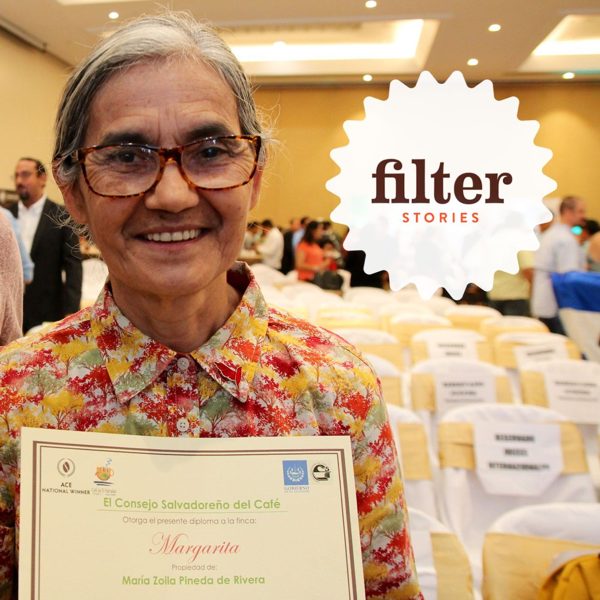
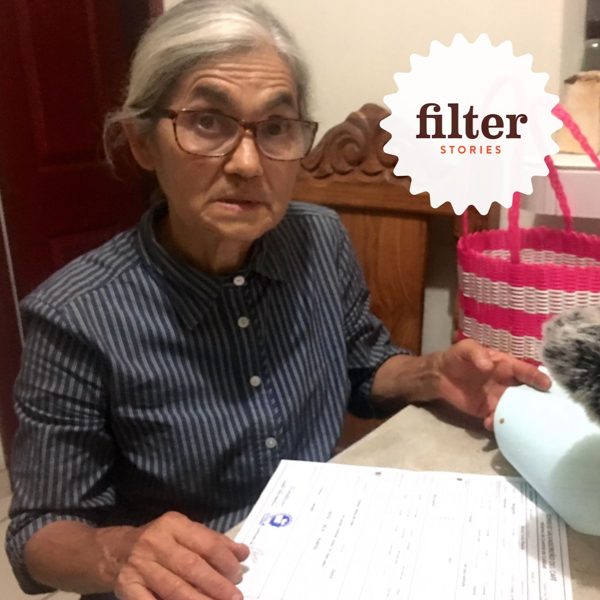
Imagine you’re a coffee buyer on a mission to buy Salvadoran coffee. We visit Armando and Maria’s farms. Which farm would you choose to buy from?
Listen to the About Face podcast here: https://www.aboutfacepodcast.com
Piano music composed and performed by James Harper
More episode information here: www.medium.com/@FilterStories
Sound mixing: Dom Edgley / www.domedgleysound.com/
Filter Stories logo design: www.headquarters.studio/
A big thanks to: Maria Zoila Pineda de Rivera, Oscar Rivera, Marco Ariz, Ignacio Gutiérrez
Editorial thanks: Janina Grabs, Jenn Rugolo, Tina Ghelani, Adam Harper
Maria and Santos were acted by Ana Kavalis and Eneko Sanz
Read the transcript
James Harper
I wake up early in La Palma, a tiny town in El Salvador in the mountains near Honduras.
Now, in the last episode, we looked at the lives of Maria and Armando, and their journeys getting into the Cup of Excellence.
To recap, if you're a coffee grower, the commodity market is a difficult, difficult place to be, especially today.
But specialty coffee gives you a solution.
You can earn more money for your higher quality coffees.
Armando had a head start, and he cemented himself as the go-to guy for specialty coffee buyers in El Salvador.
Maria has just come onto the scene.
In this episode, let's pretend we're coffee buyers, and we're on a mission to buy Salvadoran coffee.
And we're looking for long-term partners, the farmer we can buy from every year.
Who would you choose?
I'm James Harper, and this is Filter Stories, the untold stories hidden in your cup of coffee.
Maria's waiting for the bus.
She doesn't have a car, so every time she wants to visit her farm, she hops in a bus before walking up a steep rural road.
The whole journey takes up to two hours.
It's going to be a hot day today, so we persuade a neighbor to take us by car.
We wind up steep mountain roads and hop out in front of a solid metal gate.
Maria takes me on a tour of the farm.
We stop in front of some sick-looking people.
James Harper
What's your problem?
Maria Zoila Pineda
This is Roya's problem.
James Harper
Roya?
Maria Zoila Pineda
Yes.
James Harper
Roya is a common disease in Central America nowadays, thanks to climate change.
The dark, and there's a leaf here with yellow splotches and black dots.
The Roya.
Roya can dramatically reduce the size of Maria's harvest.
She's fighting it, but it costs money.
We stroll under the shade of avocado trees, the same trees that feed her community with 10,000 avocados.
Maria is on the lookout for her farm worker.
We stop at a fence on the edge of her farm.
Maria Zoila Pineda
And here, we need to build it again.
The fence is gone here.
James Harper
The barbed wire fence is broken here.
I ask, do people sneak into your farm?
Maria Zoila Pineda
They come inside.
Maria Zoila Pineda
First, they leave trash.
They take the food.
Here, I lost 100 pounds of coffee that was drying, and they took it away.
James Harper
We zigzag through more coffee trees.
Maria looking for her worker, Santos.
We spot him through the dense coffee branches.
The lining of his baseball cap hangs on by a couple of threads.
His right hand grips a machete.
We're going to talk to Santos because Maria told me in the restaurant he is one of the reasons she's looking to earn more money for her coffee.
Maria rang Santos the day before and told him a reporter was interested in meeting him and visiting his house.
He agreed.
I explained to Santos who I am and why I have a microphone.
He's going to be played by an actor.
Maria Zoila Pineda
Yeah, sure.
James Harper
It's great.
And then Maria jumps into the conversation.
Maria Zoila Pineda
I told him that I pay you $10 a day.
Here, there are some people who pay $8.
James Harper
Yes, it is normal, $8 a day.
Maria has pushed us so quickly into a conversation about money.
Part of me feels like Santos might not be comfortable in the situation.
But two things ease my fears.
For one, Maria pays Santos 30% above the minimum wage.
James Harper
Do you remember Oscar?
James Harper
And then I bring up Maria's late husband, Oscar.
Maria Zoila Pineda
Oh, yes, yes, I remember him.
Security guard
He was like a second father for me.
I remember him.
James Harper
Maria and Santos are close, like family.
I learned Santos is 37, has two young daughters, works eight hours a day, six days a week.
Santos
Yes, you have to work.
If you just lay around there, you starve.
You have to work.
There's no other way.
Maria Zoila Pineda
Yeah, he wants to visit your house.
James Harper
Oh, sure, let's go.
Here is his way.
Santos motions for me to follow him.
We slowly make our way out of the farm.
We pass the storehouse, take a left at the farm gate, and then approach a cluster of single-story houses.
Some have tiled roofs, others, metal.
We snake our way on a dirt path in between front doors, where Santos' parents live, pass an outdoor tap, and arrive at Santos' house.
The walls are a mixture of mud bricks and exposed cinder blocks.
Santos asks us to enter through the back way.
While Santos shows me around, I spot a stack of soccer trophies.
Santos
Ah, yes, yes, I'm into football.
We won some tournaments here at the regional league.
I played always midfield, but now I don't play anymore.
Now I only coach.
Aramark, you have a lot.
Yes, yes, I had a lot.
I gave some away, but I had like 10.
Well, now they don't give trophies anymore because there is no money.
Maria Zoila Pineda
And here we need a door.
James Harper
Maria points out the empty door frames and the empty window frames.
Santos
Yes, yes, yes, yes, I need a door there.
Maria Zoila Pineda
They make them for some 200 dollars.
Yeah, that's quite a lot.
Maria Zoila Pineda
Almost a month of work.
Santos
Yeah, basically a month.
Without eating.
Maria Zoila Pineda
Yes, it takes long.
Santos
Finish in the house.
If you have a family, it's almost impossible with what I earn.
If you can't fix up little things in the house, it's because you find odd jobs.
Because of what Maria can pay me, luckily I can make a living.
But it's not enough when the kids get sick.
I ask, what do you do when the kids get sick?
Yes, I have to take them to the clinic in La Palma or to a private doctor, as you wish.
Maria Zoila Pineda
Taking out a loan.
Santos
And borrowing money, because as I said, we can't save.
So you borrow the money from Maria.
For example, I ask her, she helps me a lot.
Because my daughters suffer from bronchitis.
The slightest cold makes the bronchitis flare up.
So I tell you, this is difficult.
But you do what you can.
James Harper
We get to talking about the low, low commodity price for coffee.
And I mentioned, when we in the rich north pay three dollars for a latte, your average farmer will earn three cents.
Santos
Yes, but look, the producer, for me, is the one that makes the hardest work.
And it feels really cheap.
Because you're out on the field, getting soaked, and you have to be there the entire year, and getting things.
And that's the problem with those prices.
Even our best price nowadays is not enough.
Because then the owner says, I can't invest anymore.
James Harper
The time comes for Maria and I to leave.
We sneak in between the houses, back to the road.
James Harper
Adios, gracias, para todo.
James Harper
Maria's farm and Santos' life are typical for small coffee producers who have been stuck in the commodity market for coffee.
Because Maria struggles to achieve higher prices, she doesn't have much she can invest in the farm to grow more excellent coffee.
She needs more fertilizer, more labor, more money.
Now, a coffee buyer could step in to buy all Maria's coffee every year at financially sustainable prices.
I mean, she's small after all, it wouldn't be too hard to do.
But as we know, she hasn't found them yet.
Now, let's explore Armando's farm.
Let's discover what he's doing right to attract so many coffee buyers.
I'm back in the car with Armando, and we're arriving at his farm.
Armando
Yeah, this is my mill.
Can you take a look first?
James Harper
We park up by a giant structure.
This is his mill.
On top of growing award-winning coffees, Armando has a thriving milling business.
Basically, he takes in coffee that's in parchment, he husks the green beans out of their skin, and then puts the green beans into bags, ready for export.
James Harper
We're in a room here.
It's literally almost two, three meters high ceiling.
I mean, it's just a sea of bags.
There's almost no floor space left.
James Harper
This mill is one of the reasons Armando is a popular producer.
A coffee buyer can choose one of Armando's coffees, and then Armando takes care of the milling and then the exporting.
James Harper
I mean, there must be 500 bags in here.
There's probably easily $175,000 here.
James Harper
Dozens of young men are dragging and lifting 100-pound sacks of coffee.
A couple of women hunch over a table, inspecting individual coffee beans in the middle of the noise.
During our interview back in Taco Bell's offices, Armando mentioned these employees.
How many employees do you have today?
Well, I have 100 employees permanently.
A lot of the larger farmers pay minimum wage?
Are you also doing that?
Armando
No, I pay them above minimum wage.
I pay around 10% above minimum wage on the mill.
James Harper
I guess you must be one of the most popular employees in the area.
Armando
Well, basically, everybody wants to come to work for me because I pay more.
And there's always work.
So, yeah, I mean, it's hard.
Farming is hard.
One of the things that happened last year was basically, or two years ago was that the government raised the prices to pay in the farms almost 60% up.
James Harper
For context, many have paid Santos 30% above this new higher minimum wage.
Armando
The problem with that, I'm not against it.
The problem with that is that I was giving work to a lot of people that were old people that didn't have anything else to do or to make money out of it.
And women, that was a way of living.
And now with this wage, we have to let all those people go.
Yeah, because, I mean, those people, they cannot work long time.
So we need only young people.
James Harper
Armando is not alone changing up his workforce.
Many larger farmers had to do the same to stay afloat financially.
Armando
So sometimes all these things, you know, it's not simply by raising the wage that helps.
James Harper
We leave the mill and hop back in the car and drive through the coffee fields.
We stop in the middle of the road.
Armando
This is brilliant.
I mean, this is probably one of the best flowerings that I have seen in a long time.
James Harper
This is a lucky day for me.
The coffee trees are flowering.
Dozens of tiny white flowers burst open on every coffee branch.
It's as if the coffee farm is covered in snow.
Wow, what a smell.
Extraordinary.
It's like we're in a bottle of jasmine perfume.
So you only have this smell for three days out of the year.
Yeah.
What's also remarkable is how young these trees are.
Armando had to replant a lot of his farm recently.
Armando
You really have to manage it.
I mean, one thing that we haven't spoke about it is being a coffee farmer is very risky.
Very, very risky.
What happened to me, you know, in 2014, the volcano next to my farm exploded.
And, you know, all the ashes came to my farm and reduced half of my production of coffee for the next year.
That's something I couldn't even, with all the money in the world, stop the volcano from erupting.
So I have to start from scratch.
Then the next year, the roya hit me.
The same disease affecting some of Maria's trees.
So that was another blow.
Now climate change is really, really a big issue.
Climate change is real.
Before, when I was a kid, I used to go to my farm and wear a jacket.
Now I wear a T-shirt.
James Harper
After a few photographs, we're back in the car.
Driving up the slopes of a volcano.
James Harper
Do you fertilize your trees a lot?
Yeah, we do four fertilizers during the year.
What kind of, where's it from, the fertilizer?
Armando
Well, we use what is made in Norway, which is...
Norway?
Norway, yeah.
It creates no acidity to the soil.
James Harper
It sounds very expensive.
Armando
It is expensive.
But if you're in the business where you're selling specialty coffee, I mean, if you're going to sell a meal, steak, 40 bucks for, you know, 28 grams, I mean, you have to feed the cow with the good stuff.
So the meat tastes that good.
James Harper
We park up on a plateau next to a bungalow.
A couple of Dalmatians in their 10 by 3 meter cage jump over themselves in excitement.
I stroll to the edge of the plateau and what a sight.
I mean, this is extraordinary.
Armando
I mean, this is a view all the way down to the town of Berlin.
Well, basically, I can see seven volcanoes.
Right now, all of them, they're hazed.
But there's a huge one right here.
And there's like two right here.
And there's two right here.
And there's a bunch of them.
And we're sitting in one big one.
James Harper
I mean, coffee buyers must love staying here.
Here they sign what they buy.
Armando
I mean, I don't sell coffee.
You know what I sell?
The whole experience of coffee.
So, I mean, if you want to buy good coffee, it has to start, you know, from growing good coffee.
And the place has to be clean and the place has to be well managed.
That's the way to do it.
If you want to be playing in the big leagues.
James Harper
Let's pause on this point for a second.
Roasters know that when a coffee drinker sips their specialty latte, they need to offer two basic things.
The coffee's got to taste good.
And the drinker needs to know the coffee came from an individual farm.
So, I think back to what Armando told me about coffee buyers in the Taco Bell offices.
Armando
One of the things that I understand about people that buy coffee, which I used to work also in the coffee buying business commercially, is that when people buy coffee, they don't want hassles.
You want somebody that is reliable.
You want somebody who has trustability.
You want somebody that it's not hard to sell the coffee.
It's somebody that can be trustful.
James Harper
When a coffee buyer stumbles across Maria, they see hassle.
She can't mill her own coffee.
She can't export it by herself.
Her production volume isn't consistent.
And neither is her quality.
Maria Zoila Pineda
I think it's cocktail time.
James Harper
Armando treats us to cocktails while we relax on designer furniture.
Darkness falls and Armando whips up a little campfire.
The lights from the town twinkle below.
He treats us to platters of prosciutto, continental cheese, and wine.
By midnight, I'm in bed, drunk and exhausted.
The next morning, I'm up early to leave the farm.
I head towards the sound of that hum, the mill.
It's been operating all day and all night.
I look for a way down and then spot one of the many guards who patrol Armando's property.
The guard's holding a gun and a coffee flask.
He's been up all night protecting the bungalow.
I ask, what kind of gun is it?
He explains the bullets travel up to 100 meters.
Security guard
It's about 30 bullets.
James Harper
I trek down to the mill.
Security guards open the gates for me.
And one of Armando's farm managers very kindly drives me down to the local town.
Now, I wanted to speak with Armando's workers, but I had a bus to catch to Honduras and I ran out of time.
We're back in La Palma.
Maria locks the gates of her farm.
And we begin the long walk back to the main road.
We pass coffee farms.
Some are abandoned.
Many need investment.
At today's low, low prices, this is a very common sight across Central America.
I tell her it's a beautiful road.
Maria Zoila Pineda
This area is free from violence.
There's almost none.
James Harper
It's not necessarily a quiet place, though.
We turn a corner and I hear this pumping out of a house.
Maria greets the many people she knows in this community.
Friends, cousins.
Maria Zoila Pineda
Oh, you're angry.
Well, see you later.
Thank you.
James Harper
An hour later, we're finally at the main road and we wait for 20 minutes.
Our bus arrives and mariachi bands take us back to La Palma.
A few months ago, the coffees at the Cup of Excellence were auctioned off.
Armando had two in the top 10 and his coffees fetched up to $27 a pound, pulling in over $50,000.
Maria's coffee, the 28th best on the table, fetched $4.50 a pound.
For context, that's three times the fair trade price.
And after commission, she will probably earn $6,000.
Let's ask ourselves the question again.
If you were a coffee buyer looking for a long-term partnership, who would you choose?
Maria and I hop off the bus.
I thank Maria for her time and we soon part ways.
In the next episode, we're going to look back in time to see how 150 years shaped what we just saw with Maria and Armando.
And we're going to talk about the elephant that's been in this room the entire time.
The fact that coffee in El Salvador is almost dead.
So a big thanks to everybody who jumped on board the Indiegogo two weeks ago.
Listen, we've seen how hard it is for small, marginalized producers like Maria to crack into the specialty coffee club.
And this campaign, this is a chance for us to buy her coffee and give her farm publicity.
And it gets even better.
Indiegogo selected the Filter Stories campaign as one of their star favorites and said that if we get to $5,000, they're going to promote it across their social media.
That's almost a million people.
Listen, the campaign ends on the 10th of September.
And I really, really need your support right now.
If just 10%, 1 in 10 of you listening right now picked up some coffee, we'd get there in a heartbeat.
There is no other time.
This is literally the time to support an independent podcaster like me and a marginalized coffee producer like Maria.
Let's get to $5,000.
Just follow the link in the episode description.
We can do it.
I know we can.
Thank you so much.
I also want to tell you about another podcast I think you're going to enjoy.
Now, remember Raymond, the Amish boy who left his community and then got into coffee?
You know, that was a pretty unusual Filter Stories episode.
And for many of you, you reached out to tell me how much it moved you.
It's for that reason that I think you're going to also enjoy another podcast called About Face, produced by my friend Kate.
Here's a little clip of her describing what it is.
Kate Lismore
Hi, I'm Kate Lismore, host and creator of the podcast About Face.
About 10 years ago, I was traveling around the world alone.
I had just called off my wedding and I wanted to do something really big to start over.
Five years before that, I was working at a law firm as an attorney in Manhattan.
Five years before that, I was handcuffed in a holding cell somewhere outside of Seattle.
I still have a copy of the mugshot.
Today, I'm sober.
I'm an expat with two children.
We live a couple of blocks from what used to be the Berlin Wall.
Do you remember the exact moment that set you on a path to becoming someone else?
This is a podcast about those times, the decisions, the switchback turns of our lives, the external forces that will us towards change.
It's about where we've been and where we're going.
It's about the times in our lives that have dramatically shifted us towards a new direction.
It's about who we were and who we are now.
In season two, we've delivered intimate stories about death and loss, divorce, illness, and disease, birth, choices, regrets, unearthed truths.
All of those big things that make us into someone else or perhaps just bring us closer to who we really are.
Subscribe to About Face on iTunes, Spotify, or wherever you get your podcasts.
James Harper
There's a link to the About Face podcast in the episode description.
Filter Stories was mixed by Dom Edgley, a professional sound editor.
Get him at domedgleysound.com.
And the Filter Stories logo was created by Headquarters, a branding and packaging design team.
Find them at headquarters.studio. Okay, until next time.
Listen on Apple Podcasts, Spotify, Pocket Casts or your favourite app.
More from Human Stories
See allBig and Small in El Salvador: Part 1
20 years ago specialty coffee patted itself on the back for saving coffee farmers, both big and small, from the misery of low coffee prices.
Unseen Bean: Part 2
We investigate why by putting ourselves in Gerry's shoes and experiencing the coffee world as a blind man.
Unseen Bean: Part 1
Gerry has a disability that keeps 2 in 3 adults out of full time work.