Show notes
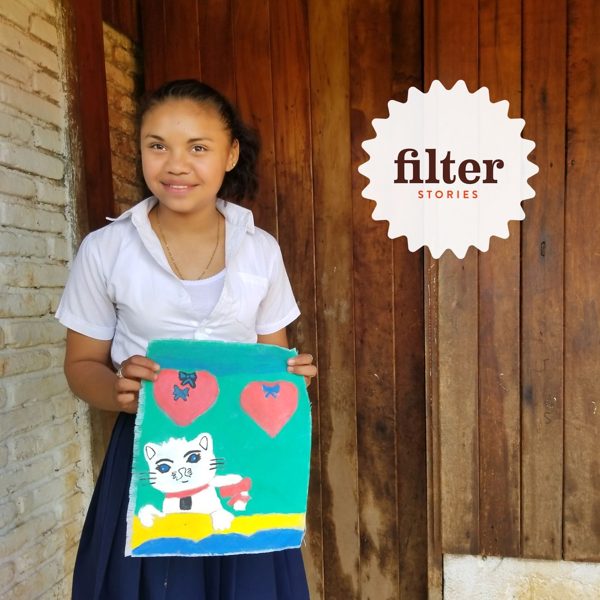
What were your dreams at 16? Sofía lives on a remote coffee farm in Nicaragua and hers is to be a great english translator.
But Sofía needs school and a lot of luck. Every morning in her blue and white school uniform she walks for an hour to school. The road is deserted and her family knows she may be attacked. And then she walks home.
Each coffee we drink holds the hopes of Sofía living a life off this farm. Or is that just wishful thinking?
Piano music composed and performed by James Harper
Transparent Trade: http://www.transparenttradecoffee.org
Project Alianza: http://www.projectalianza.org
Janina Grabs’ blog: https://janinagrabs.com
More episode information here: https://medium.com/@FilterStories
Sound mixing: Dom Edgley / https://domedgleysound.com
Filter Stories logo: https://headquarters.studio
A big thanks to: Sofia's family and the farm owner, Camila de la Vega, Janina Grabs, Tyler Wright, Amanda Eastwood
Editorial thanks: Kate Leismer, Heather Simons, Adam Harper
Whose story should I tell next? I'm planning a new Filter Stories series about the people who've built a life in coffee: the real story, grit and all. Suggest someone here.
Read the transcript
Introduction
At Sofía's house: Hello. I'm going to leave it for you, for when you want to go downstairs.
Hello, I'm James.
Hello, nice to meet you.
You're all tired.
James Harper: Sofía has just walked back from school.
Sofía: Oh, it's hot. You can tell I've been in the sun, walking.
James Harper: She's a teenager and lives on a large coffee farm in Nicaragua.
Sofía: I was tired just now. Oh, it's so much walking.
James Harper: Unlike most of us back when we were teenagers, she actually knows what she wants to do when she gets older.
Sofía: Well, my dream would be to be a great English translator.
James Harper: Sofía says she wants to become a great English translator. Why?
Sofía: I really like English.
James Harper: She's been learning English in high school for a number of weeks now, and although a little shy, she shows off what she's learned. A word?
Sofía: Thank you. You're welcome. Thank you.
James Harper: If Sofía gets into university and becomes an English translator, she will probably live a life off this farm and, with any luck, earn more than $5 a day, which is what her parents earn working on this coffee farm.
Bye. See you next time.
Every weekday morning, Sofía puts on an immaculate white blouse and knee-length blue skirt, and she walks quickly for an hour down a deserted dirt road. And she chooses to walk quickly because her parents have been overhearing rumours.
Camila: He heard somebody was planning… I don't think he overheard the people themselves.
James Harper: This is Camila, an NGO worker who's helping translate and is on good terms with Sofía's mother.
Camila: We were just talking when we were coming down here. The dad tries to walk the daughters to school, because people were telling him that some men were planning on attacking the daughters, basically, halfway, when they're coming back home.
James Harper: Physical assault is one of many challenges standing in the way of Sofía reaching her dream of being an English translator. To reach her dream, she will also need her father to stay employed, and she will need a quality education from her high school. But what are the odds of all these things working out for her?
And this story is much bigger than Sofía. She is one of hundreds of thousands of coffee farm kids in Central America. And us, we coffee drinkers, are connected to Sofía's story.
The coffee farm that keeps her parents employed produces specialty coffee, and this coffee might have landed in your $3 cappuccino yesterday. Which is why, at the end of this episode, I'm going to talk with a political economist to see what we, us coffee drinkers, can do to lower these hurdles for Sofía and everybody else.
I'm James Harper, and this is Filter Stories, the untold stories hidden in your cup of coffee.
Sofía's mother
James Harper: Let's start by looking at Sofía's life from the perspective of her parents. Her family lives in a simple brick-and-mortar cottage. They hang their clothes on a line of barbed wire.
At 16, Sofía has a much better chance of living a life off these farms than her mother did when she was the same age. Here's Sofía's mother, with Camila translating.
Camila (translating for Sofía's mother): My father was never a responsible father. As a matter of fact, he used to take from my mother's salary and use it to buy alcohol, to drink. I do remember that he abused us. He was also abusive to my mother. In the end, they decided to just part ways. My mother decided to kick him out of the house.
James Harper: As a teenager, Sofía's mother worked on a coffee farm. She did manual work like pruning and harvesting, and with the money she earned, she attended school, but just on Saturdays. But even this proved too expensive, and she dropped out of school when she was 16, the same age as her daughter Sofía is right now.
Camila (translating for Sofía's mother): Yes, when I was young, I always wanted to finish studying and have a career that would provide a stable job. I was sad because it was a dream that I wasn't able to fulfil.
James Harper: Soon after, Sofía's mother gets into a relationship and gives birth to Sofía when she is 17. It's a decision that she sometimes regrets.
Camila (translating for Sofía's mother): I tell my daughters never to have kids, because life is really hard when you have kids.
James Harper: And it appears like the message has got through to Sofía. Are there any boys that you might like in school?
Sofía says, "My mum tells me all the time that I'm lucky and I need to make the most of my luck." Sofía's parents insist she makes the walk to school every day, because if she doesn't, it'll be hard for her to get off the farm and earn more than $5 a day.
Grace
James Harper: Sofía doesn't have to look far to realise she's also lucky compared to other teenagers on the farm.
On the day I visited, a young boy faces a brick wall, crying. Next to him is his older teenage sister, who we're going to call Grace. Grace is confiding something to Camila.
Grace's verbal skills are below where they should be for a teenager, because she has learning difficulties. And she's confiding to Camila about the latest round of abuse she's suffering at home.
Camila: And we know that she suffers abuse from her sister. I've come here on days when she had wounds that weren't treated for days.
James Harper: And Grace wasn't born with learning difficulties either.
Camila: She was raped when she was little, and hurt really bad, and that's caused psychological damage.
James Harper: So the rape affected her developmentally?
Camila: Yeah, yeah, because she was very young when that happened.
James Harper: In rural Nicaragua and many parts of Central America, governments struggle to fund comprehensive social services, and underfunded police forces push cases of abuse and rape down the priority list. So Sofía, again, is lucky. She was raised in a relatively stable home, safe from abuse.
And that means today, as a teenager, she can walk by Grace's house every weekday, wave good morning to a girl who is a similar age to herself, and continue on that dirt road to get to high school. Grace will wave back to Sofía and stay on the farm. She attends the farm's kindergarten primary school.
So while Sofía studies English, Grace enjoys matching letters with their sounds on the school's tablet computer.
The road to school
James Harper: Speaking of these roads, let's take a good look at them. Sofía's house is far away from the nearest city. From the city, we hop on a public bus for 40 minutes, then a rented jeep for another 40 minutes. We drive by men passed out from drinking, lying on their backs by the side of the road.
These are the roads that Sofía walks every day: roughly 60 minutes to get to school and 60 minutes to get back to the farm.
Camila: Yes, they do the walk every day.
James Harper: Is it safe to walk to school?
Camila: A lot of parents are concerned about safety for their children. There have been cases, in communities like this, of rape. So, especially if you're thinking of two daughters.
James Harper: I asked Sofía and her sister, two teenage girls, whether they feel safe on the roads.
Camila (translating for Sofía and her sister): I don't feel safe, because sometimes there are drunk men who can start going after you. So I don't feel safe.
James Harper: I ask, what do you do when you find drunk men on the roads?
Camila (translating for Sofía and her sister): Start walking fast, because if they catch up with you, they could do something bad.
James Harper: Has anything ever happened?
Camila (translating for Sofía and her sister): Yeah, one time a man started going after them, and because their grandmother's house was a little bit closer, they just went directly there to avoid any problems.
James Harper: Do you know who he was?
Camila (translating for Sofía and her sister): The husband of one of the ladies who worked as a cook here.
James Harper: How long ago was that?
Camila (translating for Sofía and her sister): Two weeks ago.
A house closer to school
James Harper: As you would expect, the risks Sofía takes every day are a top concern for her parents. Here's her father.
Camila (translating for Sofía's father): As a father, he is concerned whenever the daughters leave. He stays thinking about how they are doing and wishes that he could at least do the walk with them, but because of work he can't. So whenever they come back, it's a joy for him that they're OK.
James Harper: Sofía's father can't join Sofía and her sister on the walk every day, because he's needed on the farm whenever there's work to do. By taking the time off work to walk his daughters to school, he becomes less valuable to his employer compared to the hundreds of others in the area who promise to be more reliable. And Sofía's mother is also in a bind.
Camila (translating for Sofía's mother): I would feel really bad if something happened to her when she's walking to or from school, but as parents there's nothing that I can do right now.
James Harper: Sofía's mother has to take care of her baby daughter and put food on the table. To join her daughters walking to school and back would eat up four hours of her day. But Sofía's parents have a plan.
Camila (translating for Sofía's mother): I would love to have her live in a city, but paying for a room, renting a room, would be impossible for us. And that's why we're trying to build a house that will be closer to the school.
James Harper: Sofía's family are planning to move off this coffee farm and closer to the local town where the high school is. Sofía's father will construct the house himself, and right now he's contemplating selling the family motorcycle to pay for the wood. Sofía's parents are doing everything they can to make her walk to school, the road to a bright future, as short as possible.
English lessons and university
James Harper: If Sofía completes high school, the odds are she's not going to get into one of Nicaragua's free but very competitive state universities. To understand why, I connect with Project Alianza. Project Alianza builds and staffs primary schools for rural coffee farm kids. And for kids in high school like Sofía, they provide scholarships and learning materials.
Camila also works for them, and I spent a few days as a fly on the wall as she visited different rural coffee communities. Camila explains why Sofía is getting a chance to learn English in the first place.
Camila: So for this year, the curriculum is changing, and all schools have to, by law, teach English. But they haven't trained the teachers. So what the kids are going to be learning, if anything, is going to be just very poor English. They're not even going to learn how to pronounce.
James Harper: Despite Camila being so encouraging of Sofía's dream to become an English translator, behind closed doors, Camila adopts a darker tone.
Camila: I mean, they've been in school since the beginning of the month, and they know three phrases: how are you, my name is, thank you.
Sofía: Thank you. You're welcome.
James Harper: Gracias.
Sofía: Thank you.
James Harper: What are the prospects for kids who have a full education here?
Camila: If they finish up to secondary school, then the problem of going to university becomes harder. The public universities are hard to get into, because the tests are just very demanding. And in general, because the education quality in rural schools is very poor, the kids often don't fare well.
And the other option is for them to just pay for a lower-quality university, and it's really hard to get that extra income for them to pay.
Sofía: Nice to meet you.
James Harper: To get to university, Sofía either needs money or a higher-quality secondary education. And right now, she has neither. Project Alianza is helping by giving her a scholarship that covers the cost of her $46 uniform. They've also provided her a smartphone, so now she can listen to accurate spoken English. Project Alianza are helping by making Sofía's road to a bright future as bright as possible.
The farm owner
James Harper: After meeting Sofía, Camila and I head back to the city, where I plan to meet the owners of this farm. I want to understand why they're not doing more to help Sofía. She is, after all, the daughter of one of their farm workers, and a teenager who lives on their property. I find one of the owners in a high-end café.
Farm owner: I'm a coffee farmer. I was born and grew up in Nicaragua. I went to school to study agriculture and business, and lived abroad for around 10 years, and then decided to come back, because I always wanted to live here.
James Harper: If there were ever to be an example of rape of an underage kid on, say, any of the roads in your neighbourhood, maybe even to your farm, how would you feel about that?
Farm owner: It doesn't happen like that, you know. It's not how you imagine it. It's not like someone will just grab you on the road and take you. It's not like that.
James Harper: The owner is basically saying that in these rural communities, things operate differently. Some teenage girls do have children with older men. Sometimes it's consensual, sometimes not. For example, the man who chased Sofía and her sister two weeks ago was not a stranger, but a man they both knew in the community. And the owner of this farm repeatedly stresses how safe the roads are.
Farm owner: You don't worry about getting attacked in the road where we have the farm. We have walked the farm, in the communities, even at midnight, and we have never had any trouble. And all the time we're alone, so…
James Harper: After a whole minute explaining why rape and assault are not an issue in his area, the owner finally answers my question: how would he feel if a girl was raped on the roads into his farm?
Farm owner: I would feel horrible, if that's your question. I would try to do something.
James Harper: My feelings towards this farm owner go back and forth. On the one hand, it's not his legal responsibility to police the roads leading into his farm, nor micromanage the sexual lives of the teenagers on his property. And in fact, this farm owner provides free, quality housing for his workers, and he's given Sofía's father a reliable job for over a decade.
On the other hand, they provide less support to education initiatives than other coffee farms in this area. And to protect Sofía from sexual assault, how hard is it to give her a 10-minute motorcycle ride? He's convinced himself that social handouts aren't going to fix Sofía's problems.
Farm owner: Regarding the social stuff, it looks nice, to be completely honest, but it's surely not the solution for people.
James Harper: To understand why he takes this approach, let's put ourselves in his shoes. What are the challenges growing coffee right now?
Farm owner: Just the whole model, it's broken. Slowly but surely, coffee is disappearing, it's shrinking, and it has a hard future ahead.
James Harper: The owner of this coffee farm is struggling. When this conversation was recorded in February 2018, the international price of coffee was collapsing towards $1 a pound, one of the lowest prices in almost 20 years. A dollar a pound.
I mean, let's pause here for a second. What does a dollar a pound mean for the owners of this coffee farm in Nicaragua? They're losing money.
Farm owner: What it really takes is like $1.80 to actually grow, here in Nicaragua, a pound of coffee.
James Harper: So $1.80. This farm needs $1.80 per pound of coffee to have a sustainable business. If he sold it as commodity coffee on the international markets, he'd earn roughly a dollar. It's barely more than half of what he needs to keep his business alive.
And in fact, after this interview, he lays off workers from the farm, and those who remain with him don't get a pay cheque for months. Sofía's father, luckily, is able to keep his job. Without this farm owner keeping a tight lid on costs, Sofía might not have a road to walk on in the first place.
What coffee drinkers can do
James Harper: Can you hear me?
I wanted to better understand what we, us coffee drinkers, can do in this situation to help Sofía.
Hello. Yes, I can hear you. Can you hear me?
Janina Grabs: OK, perfect. Yes, I can hear you as well. Good.
James Harper: So I called up a political economist.
Janina Grabs: So my name is Janina Grabs. I am a researcher on sustainability governance in commodity value chains, focusing my research on coffee.
James Harper: So I want to connect the dots —
Janina Grabs: — through the supply chain?
James Harper: Yeah. So I spent $3 on a cappuccino the other day, and I'm assuming about 3 cents of that ended up in the hands of the owner of the farm in Nicaragua. How do I make that bigger?
Janina Grabs: There are a number of initiatives, especially linked to direct trade, where I would say they're doing a fairly good job in trying to make sure that a larger amount of the consumer dollar is flowing back to the farm.
James Harper: Direct trade is a hotly debated phrase. Janina here is referring to a type of trade where a roaster buys from the same farm every single year and pays a high, sustainable price, regardless of what is happening to the international price of coffee. Most specialty roasters throw around terms such as direct trade, relationship and traceable, but they are not doing what I just described and what Janina is referring to.
Janina Grabs: In most circumstances, specialty buyers still peg their contracts to the C price. There's still much more linkage than you would actually expect.
James Harper: Most specialty coffee roasters buy their coffees from a middleman, and they pay a premium over and above the international price of coffee, also known as the C price, which right now is at $1 a pound. It might sound like they're giving the farmer a good deal, but the reality could be different.
Janina Grabs: The C price is not a very good indicator of what you should be paying for your coffee in a given year.
James Harper: So, although a roaster may say they pay 40% more than the commodity price for their coffees, 40% more on $1 a pound is $1.40. The owner of Sofía's farm needs to earn $1.80 to stay in business in the long term.
So how do we tell which roaster is doing Janina's vision of direct trade and which roaster is just buying coffee from a middleman and inadvertently paying an unsustainable price? I mean, from the outside, they all kind of look the same.
Janina Grabs: One of the very interesting new initiatives that has come up is a project at Emory University called Transparent Trade, where they've been asking a lot of specialty buyers, "What are you actually paying at origin for your pound, and how is that linked to quality?"
James Harper: If you go to the Transparent Trade website, you'll find dozens of roasters from across the world who have listed how much of the money you paid for your coffee went back to the country that coffee was produced in. And it ranges from 12% up to 45%. So the roasters at the top of this list are sending three times as much money back to the country the coffee came from.
If you can't find your local roaster on this list, you can always ask them to join. Maybe you can use it as a test to determine whether this roaster shares your values.
As valuable and long overdue as this tool is, it's not perfect. It's got a blind spot, and Sofía is hiding in it. Imagine a situation where specialty coffee is done right: we're being transparent, prices are good, it goes to the farmer. But this is a larger estate. How would we have any assurance that the money would go down to Sofía's parents?
Janina Grabs: That is a very good question, and I don't think that we have very good answers for it.
James Harper: At the end of the day, we coffee drinkers are going to struggle to get bona fide assurance that paying more for our cappuccino equates to more money in the hands of Sofía's parents. How do we reach Sofía? How do we get her to a position where she has enough money in her pocket, or her parents do, to give her the chance at a decent education, to get her to university, to be an English translator?
Janina Grabs: Of course, there are an increasing number of companies that support NGO-driven projects like the one that you visited —
James Harper: Janina is referring to Project Alianza.
Janina Grabs: — where, at least for a small and select number of children and youth, they are trying to help them find employment alternatives, try to educate them, try to…
James Harper: But that feels like a band-aid.
Janina Grabs: Right, it is. On a larger scale, what you would need to be tackling is simultaneously the lack of financial stability of this sector, the institutional capacity of the entire state system, the educational reforms, the lawlessness that you have identified.
James Harper: Janina's list goes on and on. Zooming out this far and seeing the mountains standing in Sofía's way to reach her goal of being an English translator, I begin to wonder whether she's dreaming too big.
Imagine you're Sofía's mother. Sofía takes huge risks to her safety every time she goes to school, and the education she's getting is substandard. You will not be able to afford a good university for her, because you earn $4 a day. What is the best that Sofía's mother can hope for her own daughter?
Janina Grabs: I mean, quite honestly, if you try to think rationally about this, one answer that a lot of people arrive at is: encourage her to migrate up into the United States, right? This is why we're seeing all of those caravans happening, and they're very linked to the situation in coffee and other commodity crops.
I would not say that I encourage that option, but I understand the rationale behind it.
A year later
James Harper: It's been a year since I spoke with Sofía and her family. As low coffee prices hit rural communities very hard, political unrest in Nicaragua led to the government murdering hundreds of protesters. You can learn more about this in episode 6 of Filter Stories, Aquiares.
Sofía's father downgraded the family motorcycle and scraped together money to buy wood to build the new home, which is now closer to the secondary school. Sofía has two more years left of high school, and she's still set on becoming an English translator.
Grace was raped again. Grace's family reported it to the police, but the police didn't investigate further. The family of the teenage boy suspected of raping her denied involvement and moved away. Grace then discovered she was pregnant, and Project Alianza covered the costs of getting her to see a doctor to deliver the baby.
The international price of coffee is still at a dollar a pound.
Outro
James Harper: Hey guys, thanks for listening. This was a heavy one. Thanks for sitting through it. I've got to say, I even shed a couple of tears after I put this one together. I love a happy story, as we all do, but this one was really important, and I didn't want to hold back any punches. This is the reality of how things are in many parts of Central America.
And along those lines, that's kind of the reason why maybe you will have noticed that it was pretty heavily anonymised. You don't know who the farm is, you don't know where in Nicaragua this took place. Even Sofía, that's not her real name. She didn't want me to use her real name. The farm owner, definitely anonymised. This wasn't a piece of gotcha journalism, where I was going to vilify somebody here. The system is broken, and I just wanted to point that out.
But speaking of Nicaragua, and Aquiares, the Kickstarter went really, really well. In a week, we got over 200% funded. It's so cool that so many of you came together with this. I'm really excited to send you this coffee, and this little personalised card from Alfonso that he's signing very soon. So you can put that up on your fridge with our Filter Stories fridge magnet. There's still time to get involved. The Kickstarter ends on the 20th of March. There are links in the episode description.
I'm about to leave Berlin for a little while to collect some more stories. So if you're interested in following my travels, the link is in the description.
Listen on Apple Podcasts, Spotify, Pocket Casts or your favourite app.
More from Human Stories
See allAquiares
In Central America, you can’t tell the story of coffee without mentioning war.
Tito, the Panamanian rebel
Tito lives on a mountain in Panama, is a rebel and doesn’t listen to anyone.
Amish
Raymond's family want him to spend his life using a horse instead of a car, to live off the grid and have little contact with the outside world.