All episodesThe Coffee Producer Toolkit
Farming, Pt 3 — Starved soils and vanishing labour
Show notes
This episode explores what plants really need from the soil beneath them, and the labour shortage forcing farms to rethink how the work gets done.
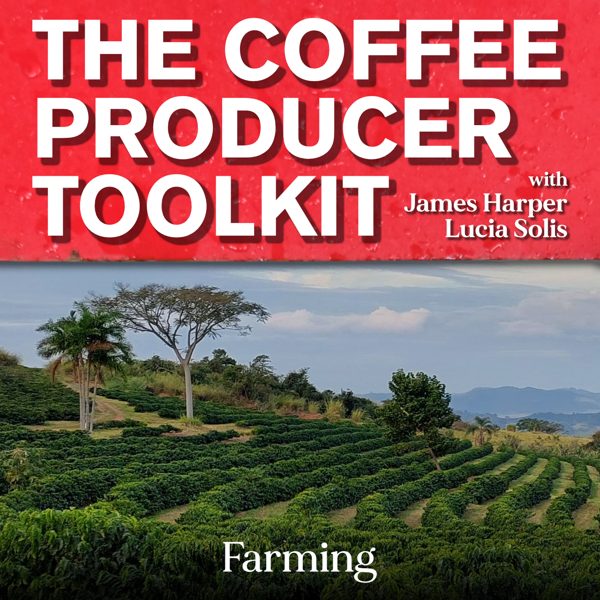
Part of The Coffee Producer Toolkit, a series made in collaboration with Lucia Solis, it will help you understand coffee farming better than most professionals you'll meet at a trade show.
Each episode takes one part of the farming business — agronomy, processing, fermentation, storage, quality, sales — and lays out what the best farms are actually doing.
Stay up to date with Lucia through her newsletter
Related podcast episodes:
Lucia:
James:
People mentioned in the episode:
- Fernando Castillo Guatemala
- Paulino Quintero, Colombia
- Orlando Osoria, Colombia
- Julia Ortega, Mexico
- Sergio de la Vequia, Mexico
- Hugo Lopez, Innovakit
- Manuel Mata, Colombia
- Sam Knowlton, Soil Symbiotics
- Lalo Perez, Biofilia
Resources:
- Anacafe technical management
- Coffee Cascara Compost Guidelines (English)
- Compostaje de la pulpa/cáscara de café (Espanol)
- Netafim Drip Irrigation manual
- Innovakit: abonador (fertiliser applicator)
- Innovakit: aroplateo (tree guard for weed whacking)
- Innovakit: selector de arvenses (low-drift sprayer)
- Innovakit: canguaro (sleeves)
- World Coffee Research variety catalogue
- Recommended varieties: Centroamericano, H1, H16, Mundo Maya
- Coffee&Climate Toolbox
- Access Agriculture
- World Coffee Research Resources
- Barista Hustle’s Coffee Farm Management series
The Coffee Producer Toolkit is made possible by these leading coffee organisations:
The Coffee Quest | BWT | Descamex | InterAmerican | Pinhalense | Novonesis | GrainPro
Read the transcript
Filter Stories interlude: plant nutrition
James Harper: Welcome back to Filter Stories, I'm James Harper. And now we've arrived at the third and final part of the first episode of the Coffee Producer Toolkit, focused on coffee farming.
Just to remind you, like I mentioned at the beginning: coffee farming is the coffee industry's biggest blind spot, and yet it underpins our $200 billion plus industry. And so With this series on Filter Stories, me narrating here, I'm trying to help you understand coffee farming so that you will actually be more knowledgeable than most coffee professionals you're going to meet at a coffee trade show. And I think it's going to change how you see the entire industry forever.
So far we have covered metrics, water, genetics, replanting. Now in this third and final part, we're going to cover plant nutrition, cherry pulp fertilizer, and labour and tools.
So let's talk plant nutrition. The big piece of advice Lucia and I give is that farmers have to understand what nutrition their plants specifically need. This might sound really obvious, but let me give you the context here.
Coffee farmers are not agronomists. They're managers. They manage the farm, but they don't have a deep understanding of why their plants work the way they do. Some of the very large farms have the resources to hire a dedicated agronomist, but the smaller farms definitely don't. So when it comes to plant nutrition — what kind of fertilizer, how much fertilizer to apply — they turn to the best, most authoritative source of information available to them. And very often, that is their national coffee institute: Anacafé in Guatemala, IHCAFE in Honduras, the FNC in Colombia, and so on.
Okay, now put yourselves in the shoes of these national coffee institutes. Here you have tens of thousands of farmers who all need advice from you. How much fertilizer should we apply? Which kind of fertilizer should we apply? Ideally, what you would do is a foliar and soil analysis, so you look at the minerals that are in the soil, you look at the minerals that are in the plant, you'd see what minerals have got through, what the balance of nutrients is, and then you'd recommend a personalised recipe. But you can't do that for tens of thousands of farmers over and over again. It's just not practical. Instead, what you give them is average advice: we'll do a few analyses of the soil and the plants in different regions, and based off that information, on average, we recommend this as a solution. So the fertilizing advice is a one-size-fits-all solution. It has to be.
But the thing is, each coffee farm has individual needs. And if you apply the same fertilizer over and over and over again in the same region for decades — which is what happens — that can actually create an imbalance in the soil of one particular nutrient, which then inhibits other nutrients from getting through. And so the plant paradoxically becomes starved of a nutrient, even though there's plenty of it in the soil.
I have met farmers, for example, in Honduras, when I went to the Let's Talk Coffee event organized by the coffee importer Sustainable Harvest. I met a producer whose farm was inexplicably losing yield year after year, and the reason was that they were applying the same fertilizer as recommended to them by their national coffee organization. But that specific balance of nutrients was actually harming their trees.
So the advice that Lucia and I give in this next section is really just raising awareness. Look — don't just trust the advice given by your national coffee institute. Take ownership of what your plants actually need. And this will be very new information, especially for smaller producers. So our goal here is really just awareness, and then hopefully, through their own research, they can find solutions that work for their specific farm.
And so with all that out of the way, let's listen. Pressing play.
Plant nutrition
James Harper: Fertilizing your coffee trees — which, to me, as anon-agronomist, sounds pretty simple, right? You just put the nutrients in the ground, the trees take them up, and they grow better. Right?
Lucia Solis: Exactly. End of section.
James, when it comes to nutrition, most farmers would do what Paulino used to do. They follow the advice of local government agronomists, who tell them which fertilizer to apply, how much, and how often.
Paulino Quintero: Bueno, lo tradicional de la zona era anteriormente fertilizar, si acaso, una o dos veces al año.
Lucia Solis: This advice has been handed out for years by coffee organizations all around the world. But there is a very big problem with it: the advice they're offering is average advice. It's a one-size-fits-all recommendation. But in practice, that means it doesn't fit anyone's farm particularly well.
Lalo Pérez: Y resulta que el promedio para mi finca es fatal.
James Harper: Lalo goes so far as to say that this advice can even be fatal.
Lucia Solis: What both Lalo and Sam strongly believe is that there is enormous value in understanding your own soil, running your own analysis, and figuring out what your specific trees actually need.
James Harper: And when you get that right, the improvements to your plants' health and yields can be enormous.
Lucia Solis: Sam shared with us a story that shows exactly why getting your nutrition right for your specific farm can make a huge difference to your profitability.
James Harper: And in this story, Sam mentions NPK. NPK stands for nitrogen, phosphorus and potassium. These are nutrients plants need to grow, and they are the building blocks of most fertilizers.
Sam Knowlton: There's one farm I can think of where they were basically, for decades, applying these rates of NPK, and essentially saw a huge drop-off in production, huge increase in disease and pest incidence, and were basically at a point where they weren't sure if they could continue to farm economically.
So we took a soil analysis and did a whole kind of farm diagnostic and assessment, and saw that really the bottlenecks in the system were not due to a lack of nitrogen, for example. So what we did is a more holistic, integrated amending approach, where we balanced out all of the minerals in the soil that we were able to test for. So calcium, magnesium — we're looking at all the trace minerals as well — and got them more balanced out in the right ratios to each other. So we're not creating antagonisms where an excess of one blocks the uptake of another.
And so we did this over time, and we pulled back eventually 100% on the nitrogen applications. So we stopped applying the synthetic nitrogen that had been recommended for decades. And we did another type of analysis where we're looking at the nutrients in the plant sap and the tissue. And every year for the past seven years, the ranges of nitrogen have been in the ideal range, without the application of synthetic nitrogen. So that just goes to show that they were over-applying for years and years and years without knowing.
Lucia Solis: So the farm in Sam's story was in decline. Yields were falling, profitability was sliding, and the root cause was simple: by following only the generic advice handed down from national coffee organizations, the farm had been failing to meet its plants' specific nutritional needs for years. And the result was a financially unprofitable farm.
It was kind of ironic that adding the nitrogen was causing the trees to be sick. And when they stopped over-applying nitrogen, the trees were actually able to better resist the pests and diseases that were plaguing them.
James Harper: Okay, so now we're going to cover practically what you can do to get a better handle on your plant-specific nutritional needs.
Lucia Solis: Lalo's starting point is two tests.
Lalo Pérez: Con un análisis de suelo. La otra cosa que es esencial es tomar análisis foliares también.
Lucia Solis: A soil test and a foliar test.
If you're unfamiliar: a soil test is literally just taking a sample of the soil at the base of the coffee tree, and then you send that to a lab, and they will tell you what nutrients you have in your soil. Whereas a foliar test is when you take a leaf from one of the coffee trees, and then you send that to the lab, and they'll break it down for you, and then they'll tell you what specific nutrients your plant might be deficient in.
James Harper: Now, in Latin America, a soil and foliar analysis might cost you somewhere between $150 and $400.
We also want to be clear that this is a different test from another test you might be familiar with, the circular chromatography test, where you put an extract of soil in the middle of some treated paper and it slowly migrates outwards, creating these feathery ring patterns. That test reveals the soil's vitality, how biologically alive it is. But it doesn't give you mineral numbers. And mineral numbers are what you need — that's what soil and foliar analyses give you. Those precise numbers.
Lucia Solis: Now, when you do these tests and you get back the results, you might see that your soil is actually not deficient in any minerals, that it has plenty of them. But don't be fooled. Because just because a mineral exists in the soil, it doesn't mean that the mineral is actually making its way up into the plant.
Lalo Pérez: La translocación de nutrientes no es lineal.
James Harper: Lalo explains that there are many situations where the plantitselfis lacking a specific nutrient, and yet, paradoxically, the soil has plenty ofit. So the problemisn't a shortage of a nutrient, it's an imbalance of nutrients. Take the example of potassium.
Lalo Pérez: Si en tu análisis foliar te falta potasio, no necesariamente significa que en el suelo falte potasio.
James Harper: If your foliar analysis shows that your plants are deficient in potassium, your instinct might be to apply more potassium. But by also doing a soil analysis, that would reveal that there's already enough potassium in the soil — and the real issue is that that potassium is being blocked by an imbalance of calcium or magnesium. Without these tests, you would never know.
Lalo Pérez: Y realmente lo que está limitando el potasio es el calcio, o el magnesio, o el desbalance entre nutrientes.
Lucia Solis: So it's kind of like sending a package, and the UPS man keeps sending the package and sending the package, but it's just left at the door and no one is receiving the package. So just because something is being delivered, doesn't mean it's actually being accepted. And the balance of minerals is what matters, because it tells us what a plant can digest.
James Harper: Now, from Lalo's experience, he also sees that the pH of the soil could be the thing that's stopping the plant from absorbing the nutrients from the soil.
Lucia Solis: The pH is really important because it affects what the plant can absorb. So the pH is maybe the lock that lets you open the door and actually receive the packages that the mailman is delivering.
Lalo Pérez: Y aqui es importante saber qué esta buscando uno.
James Harper: So this now brings us to what kind of soil analysis you should actually be looking for. Many coffee institutes and agencies offer free soil analyses, but Lalo warns that these tend to be limited. They cover the obvious nutrients like nitrogen and potassium —
Lalo Pérez: Sin embargo, hay otras partes que son casi mas importantes.
James Harper: — but there are other measurements he considers even more important: the soil's pH, its cation exchange capacity, and its base saturation. These factors determine whether the plant can actually absorb the nutrients that are already there in the soil. So when you're looking for a lab to do a soil analysis, make sure it covers those other measurements too, not just the major nutrients.
Lalo Pérez: Por ejemplo, la parte del pH, la del intercambio catiónico y la parte de saturación de bases, yo la encuentro más importante que los nutrientes.
James Harper: Now, Lucia, I can imagine that many listeners, when they hear terms such as "base saturation", "cation exchange capacity" — not to mention the names and functions of the maybe 70 nutrients that Sam Knowlton estimates plants actually need to thrive — this is extremely complex information. How can a producer wrap their heads around this very complex information they're going to get back from these testing labs? A listener may be thinking to themselves, is there maybe like one thing I should pay attention to more than any other thing?
Lucia Solis: Well, listeners, Lalo has advice for us on this front as well. He has a very sobering saying. It's: es bien sencillo — no lo es.
Lalo Pérez: Me gusta una frase que digo: es bien sencillo, no lo es.
James Harper: Yes. Actually, Lalo said that exact same phrase to me the first time I met him, quite a few years ago in Honduras.
Lalo Pérez: Understanding soil biology is really simple. It's not — it's just not simple. It's extremely complex and dynamic. And we have this tendency for linear thinking. We have a culture of linear thinking, not only as humans, but also with our scientific culture. And so we always want to Know, like, what is the one thing that — and it just doesn't work that way in nature.
Lucia Solis: And I think what we want to emphasize here is that, yes, it is a complex biological system — soil and plant nutrition. And Lalo is making it clear that there are no easy shortcuts. So the bad news is, James, there's not one thing that you can do to improve all of your farm.
James Harper: Mm.
Lucia Solis: But with resources, Lalo and I believe that there are a lot of things that you can learn yourself, and educate yourself on some of these topics, and hopefully get access to other people that can help you.
James Harper: And Lalo has a wider philosophical point.
Lalo Pérez: Estamos obligados a responsabilizarnos sobre nuestra actividad.
James Harper: He says, if you're going to farm, you need to be an expert agriculturalist. But there is good news.
Lucia Solis: We're in a unique era where a lot of coffee producers can self-educate in a way that hasn't been accessible before.
James Harper: Ask around. Go to the fertilizer companies — they will have trained agronomists on hand. Find people in your network. Do these tests yourself and become an expert in your coffee trees. Figuring out your plants' nutritional needs will boost your plants' productivity, it'll increase their disease resistance, it'll lower the amount of money you're spending on fertilizer inputs. Your farm will be more profitable.
Coming up next: making your own cherry pulp fertilizer. But done well.
Filter Stories interlude: cherry pulp
James Harper: Pressing pause. So now we talk about cherry pulp. Let me explain what it is.
During the harvest you pick coffee cherries, and deep inside the coffee cherry is a green bean, which is the bean we're going to roast and brew our coffee with. But you have to get rid of all that fruit flesh all around it. It's actually not dissimilar to a cherry from a cherry tree, and it also tastes very sweet and is delicious. I really recommend you try some if you get a chance.
Anyway, in the wet mill, producers have to get to the green bean by removing all the fruit flesh. And then they have a problem: what do I do with this mountain of coffee fruit flesh? Historically, what's happened is that it's gone straight into the local waterways, which was an environmental catastrophe. Fortunately, these days that's much rarer, but producers nevertheless have this problem, where they have just this mound of fruit flesh and they have to do something with it. And what Lucia has seen over the years is that the way producers treat this coffee flesh is very far from ideal.
But the amazing thing is that this coffee fruit is a fantastic organic fertilizer. And it's actually really important that producers do bring this coffee cherry flesh back onto the farm, because farms could really, really benefit from this organic matter.
So here's the thing. Historically, many coffee farms were created by perhaps burning a forest and then planting coffee trees in the ashes. It's terrible, I know, but that's the way it was. Now, that soil had hitherto been full of organic matter, lots of micronutrients — just fantastic material for a coffee plant to begin growing. And they grew, over and over and over again, and they would continue to produce harvests for decades.
But the thing is, every time a coffee plant produces a harvest, it takes nutrients from the soil. Creating fruit takes a lot of energy. It takes a lot of minerals. It takes a lot of water. And coffee trees are bred to produce a load of coffee cherries — commercial coffee plants produce so many more cherries, so much faster, than a comparable plant in the wild. And so that is just a lot of nutrients, water and energy being taken year after year to produce harvest after harvest.
In the wild, all those nutrients and energy would be recycled within the ecosystem. But on a commercial coffee plantation, this fruit is removed from the ecosystem. And so the soil over time just gets depleted of nutrients. And if you want to sustain coffee production, you have to add those nutrients back in.
Since the invention of synthetic chemical fertilizers, this is how the nutrients were added back into the soil: by throwing blue pellets around the coffee trees. But the thing is, you don't need as much artificial fertilizer if you just use the cherry pulp on your farm. And what's crazy is that not more producers do it, because it helps them reduce their fertilizer bill, and that nudges them up the profitability ladder. And especially now, when, for example, the Strait of Hormuz is blocked and fertilizer prices have skyrocketed — that is a major cost for farmers, and anything to reduce that cost improves a farm's long-term profitability.
And a quick aside: you might be wondering, is it enough to just use cherry pulp fertilizer? Could a farmer actually not have to spend any money at all on chemical fertilizers if they just recycled their cherry pulp? Well, no. And it really is the same reason as before: because of course the coffee plants are not just producing the cherry pulp, which is what hopefully is recycled, but also producing green seeds, and they themselves are tremendous stores of minerals and energy. But those seeds have to be sold, so there is a loss there, and it has to be replaced somehow.
So it's more economical to recycle the cherry pulp and then also add a little bit of synthetic fertilizer. Farms can go fully organic, replacing synthetic fertilizer with organic inputs, but that actually becomes very costly. You have to truck in a lot of organic material like chicken dung, sawdust, these sorts of things, and that starts getting expensive. And you have to apply a lot more of it as well, which becomes more taxing on your time.
All right. So let's hear some bread and butter advice for how to properly compost your cherry pulp. Pressing play.
Cherry pulp
James Harper: At harvest time, your farm will generate an enormous amount of cherry pulp, and you have to do something with it. You can't do what was done 50 years ago and just dump it into the surrounding waterways. We all know that is catastrophic for the environment.
Lucia Solis: When we can break it down and get all of that rich organic matter, it can be really beneficial to your soil. In most of my work, I see that this is a very neglected part. Most of the cherry pulp is not handled at all — and not handling it at all means having the cherry pulp just sit in a pile and rot on its own. When it's properly treated, it adds to the nutrition of the soil, which we know directly adds to the health of your trees.
James Harper: Let's quickly cover best practice when it comes to making your own fertilizer. And for this we spoke to another agronomist, Manuel Mata from Colombia.
Manuel Mata: Mi nombre es Manuel Mata. Yo soy ingeniero agrónomo egresado de la Universidad del Magdalena.
James Harper: Manuel has spent much of his career offering agronomic advice to coffee producers across his region near Santa Marta in northern Colombia.
Lucia Solis: You know, one thing that I've seen a lot is that a lot of coffee growers will take the pulp of the coffee cherry, and you take that coffee pulp and you just put it on the ground at the base of the coffee tree. And maybe you're listening to this and you're thinking, well, I do that — what's wrong with that? Because the logic makes sense. That's what would happen in nature. If there's a tree and you have fruit that isn't picked, it would just fall to the ground, and it would be decomposed and recycled back into the tree.
Manuel Mata: Tiene un nivel de acidez muy alto.
James Harper: Manuel explains that the problem with this approach is that coffee cherry pulp is highly acidic. And so if you simply pile it up and leave it under the coffee tree, it's going to change the pH of the surrounding soil. And as we've heard, getting your soil's pH right is critical. If your soil is too acidic, your plants are going to struggle to get certain nutrients.
Manuel Mata: El suelo va a cambiar de pH y eso te va a dañar la plantica.
James Harper: The solution, of course, is composting the pulp properly before applying it, and almost all producers who produce specialty coffee do this. But Manuel is clear that how you do it matters enormously. And actually, here there is one simple indicator that you're getting it wrong.
Manuel Mata: Va a sentir el mal olor.
James Harper: The smell. If your compost pile has a foul, rotten smell, Manuel says the decomposition process is happening incorrectly.
Manuel Mata: Cuando uno siente mal olor es porque la descomposicion de la pulpa es de forma incorrecta.
James Harper: A healthy compost shouldn't smell bad. In fact, it shouldn't smell at all.
Lucia Solis: Yeah, in my experience, that rotten smell is incredibly common. And it's been really funny when I've been on some farm visits with clients, and there are also buyers who happen to coincide with my visits, and I just hear about how much they love that smell — because they were associating this decomposed cherry with the harvest and with their trip and, you know, all of these romantic elements. But really, it's a rot aroma. So it's kind of one of the stranger things about origin tourism and specialty coffee: that sign that people find romantic, for me is actually a sign of mismanagement.
James Harper: So what's going wrong in the compost?
Lucia Solis: Manuel explains that the foul smell is actually coming from the centre of the pile, the part that isn't getting enough air.
Manuel Mata: Lo que va a hacer es que ese centro que tú no aireas se descompone, y va a sentir el mal olor.
Lucia Solis: The decomposition happening there is anaerobic, and that's what causes the rot. And so the solution is simple: turn the pile every couple of days, just physically rotating it. It ensures that the centre gets aerated regularly and that the whole pile breaks down correctly. And also remember to Keep it somewhere sheltered, out of direct sun and away from rain.
Manuel Mata: Y que no le caiga lluvia.
James Harper: And a little bit of engineering can also go a long way. With Paulino, who we heard from earlier, the Coffee Quest team worked with him to design a simple but effective composting system.
Paulino Quintero: Acá en la finca Las Brisas, la pulpa de café se deposita en una fosa.
James Harper: Today, what Paulino does is he deposits his coffee pulp into a covered pit with a slatted floor. That way, the liquid — what he calls honey water — drains away rather than sitting trapped inside the pulpitself. He then collects that liquid and reapplies it back into the pile. He also turns the pile regularly, and adds liquid microorganisms to accelerate the decomposition. And he knows the process is working because there is no foul smell.
Paulino Quintero: Se pierden esos olores.
James Harper: In his case it takes around six months, and then the compostis ready. Fully broken down, rich with nutrients that his plants can actually absorb.
Lucia Solis: James, I want to be clear that collecting and decomposing the cherry pulp can help subsidize the cost of fertilizer. But if you are really trying to move away from synthetic fertilizers and use only the compost that's produced on your farm — that process is not cheap, because it takes a lot more inputs. And a lot of the time producers have to bring in external organic matter, potentially from other farms or other sources. So it can get really expensive to completely replace your fertilizer inputs using only your cherry pulp as a starting tool.
But what we're trying to say is, it's a really great supplement that can help cut down that bill. And when cherry pulp is untreated, it actually creates a problem. So if we can turn this problem into subsidizing fertilizer inputs, then that is a cost saving.
James Harper: And so: get your composting right. You'll stop polluting your water and damaging your trees, which is bad for the long-term health of your farm. And instead, you can improve the microbiology of your soil. This will build your trees' natural defences against pests and diseases, and that will protect your yield — and higher and more consistent yields help you become more profitable.
Coming up next, we explore some ways to reduce your labour costs so your farm can be more profitable.
Filter Stories interlude: labour and tools
James Harper: Pressing pause. Okay, so this final section of the episode covers labour and tools. Now, you might be thinking, this is really obvious — of course farms have to think about tools that speed up the job. But what's remarkable about the advice we give in this next section is that it's actually very novel advice, especially for smaller producers.
As Lucia will explain, for the longest time many farming communities didn't have to worry about finding efficiencies in their work, because labour was always so abundant. There was always someone you could employ to do the job. But rural labour is now one of the biggest issues facing coffee farmers. There is very little money in coffee and, understandably, people don't want to stay in the industry. We have seen enormous urbanization these last 50 years, as people move from the countryside into cities.
Of course, what's interesting is that we have seen this same phenomenon of urbanization also in the global north, in Europe, in North America. European and North American agriculture also has issues with labour scarcity. And we are very familiar with the two solutions they've found. One: the mechanization of agriculture. And in the cases where it's just too difficult to mechanize, solution number two: they bring in labour from neighbouring regions that are poorer. So in North America, that's mostly people from Central America. And in southern Europe, for example, that's people from North Africa — typically paid very little and treated very poorly.
So that's how Europe and America have fixed the problem. And in the Latin American farming context, that is also done to some extent. You see it mostly during the coffee harvest. So if, for example, you have 10 permanent workers on the farm, you might need 10 times that number, 100 people, to pick the coffee cherries during the harvest window. And that labour can be migratory labour, right? So it could be indigenous peoples who move country to country — Nicaraguans might travel south to Costa Rica. Finding pickers at the right time is one of the biggest headaches for a coffee farmer, and I have so many stories about it.
But a new issue is actually the permanent workforce. These labourers have to live in the community close to the farm, because they are needed all year round. But because of a lack of money in coffee farming, very few people want to do the job. They just can't get paida competitive wage relative to what they could earn in the city. And coffee farmers are very rarely able to import people to do the job, because there's very little money in coffee farming, period. If someone's going to migrate anywhere to work, they're probably going to the US, where the wages are way higher.
So coffee farming has now changed. Abundant labour is no longer the norm. There's very little money in coffee, and importing labour is not an option. And so Lucia and I think the solution for many coffee farms is to embrace productivity-enhancing tools. It might seem really obvious to you, but this is genuinely a novel concept.
And this is also the final section of this episode. I'm not going to press pause again — I'm just going to let the credits roll out. I look forward to speaking with you in the next episode, on post-harvest processing.
Here we go. Pressing play.
Labour and tools
Lucia Solis: Okay, so now let's talk about labour. Because labour, and the people involved in making coffee, that's getting increasingly scarce.
James Harper: And we really got to hear how big an issue this is when we spoke with Sergio de la Vecchia, a coffee producer in the state of Veracruz, Mexico.
Sergio de la Vecchia: Mi nombre es Sergio de la Vecchia, soy de la finca De la Vecchia, aca en Huatusco, Veracruz, México.
James Harper: His family runs one of the largest coffee farms in the region. And at his scale, during harvest, he employs basically an entire village of people. But because he employs so many people, he feels today's labour scarcity very strongly. Many workers, he says, migrate north to the US and Canada.
Sergio de la Vecchia: La realidad es que ya estamos compitiendo con otros cultivos.
James Harper: And those who stay are increasingly being enticed away to work on other crops: avocado, chayote, lemon. The pressure has got so severe that Sergio had to scale back his expansion plans entirely, reducing his growth rate by 60% because he simply couldn't find the labour.
Sergio de la Vecchia: Lo redujimos el 60% porque nos preocupó la falta de mano de obra.
Lucia Solis: And there it is. There is your lack of profitability as a farm, when you cannot even grow as a farm. Because even if you wanted to grow, you can't find the labour. But we don't even have to talk about growth. We can also think about, if you just want to operate at your baseline, and you don't have the people to do that — I've definitely seen some farms just selling their cherry when they're not able to do the next step.
James Harper: Now, in Brazil, almost every coffee farmer is using tools where they can. Lucia, what's the context here for why this is a novel idea outside of Brazil?
Lucia Solis: Because labour has been available historically, there have been a lot of people to work. Efficiencies didn't need to exist. You could just hire somebody or have them work extra time. A lot of farmers aren't used to thinking about how to make the process more efficient, because they haven't had to. But now we're in a world where you have to find efficiencies using tools.
James Harper: And that is exactly what Sergio has done.
Sergio de la Vecchia: Nosotros hemos tratado de tecnificar un poco las labores culturales.
James Harper: He has tried to mechanize as many aspects of the farm as possible. The harvesting still remains manual, because his land is too mountainous. But the non-harvest work — clearing weeds, applying fertilizer, fumigating — he has mechanized a lot of these tasks, and he's been able to reduce his labour needs by around 15%.
Sergio de la Vecchia: Con eso yo creo que hemos tenido una reducción del 15% de mano de obra.
Lucia Solis: But James, you know, a producer might think that 15% — that's not a very big difrerence.
James Harper: Yes, 15% might sound modest, but let's think about what that actually means in practice. On your farm, if you're working a typical six-day week, a 15% efficiency gain means roughly a full day saved every week. That's 52 days a year. That's getting close to two months saved every year. So ask yourself, as a producer: what could you do with an extra two months of time on your farm?
Lucia Solis: So let's specifically look at the tools you could invest in.
For a large producer like Sergio, he's going to want tools that can do very serious volumes. But they can cost a pretty penny. We're talking a battery powered pruning saw, a motorized sprayer, a mechanized fertilizer spreader — maybe a thousand dollars all in for these tools, per worker. For a farm at Sergio's scale, in such a tight labour market, that investment absolutely makes sense, because these tools are designed to get through tens of thousands of coffee trees efficiently.
But what if you're a smaller producer? Well, I think in that case they're definitely overkill. But that doesn't mean smaller producers should ignore the opportunity to find efficiency gains on their farm. If anything, it matters even more when you're small. Without the luxury of hired help, you're doing more of the work yourself, or your family's doing the work. Your farm might be so small that you're holding down a second job. So any tool that saves you time and reduces your input costs while delivering the same results is essential. And the good news is that cheap, effective tools do exist for smaller producers.
James Harper: So what we're going to do now is walk through three areas where tools exist for smaller producers that can dramatically speed up the work of running a coffee farm. The first is applying fertilizer. The second is weeding. And the third is spraying.
So let's talk about fertilizing.
Lucia Solis: So, when it comes to applying fertilizer, it may not sound like the most complicated job on the farm. The traditional approach is very simple: you strap a sack of fertilizer pellets to your body, you walk the rows, and you bend down at each tree and you scatter the pellets at the base of the tree, one tree at a time. Pretty simple.
James Harper: But this could be done a lot faster and with a lot less effort. There is a tool developed by a company in Colombia called InnovaKit, where instead of having to bend down every single time to spread pellets at the base of the tree, this InnovaKit tool speeds it up. It's only $30. It's a simple plastic tube, and there's a flap at the bottom of the tube that disperses the pellets as they fall, spreading them evenly around the base of the tree rather than landing in a single pile.
And I reached out to a producer who actually uses it: Astrid Medina.
Astrid Medina: Mi nombre completo es Astrid Medina. Mi finca está en el departamento del Tolima, en Colombia.
James Harper: Astrid has about 14 hectares of coffee, and she told me the tool made a real difference. Because instead of having to bend down every single time at every single tree, now she just walks upright along the rows of coffee trees. It's faster, easier, and doesn't wear her body out.
Astrid Medina: Se dispersa muy fácil. Eso no toca caer, que uno va paradito, avanza, avanzando, muy práctico.
James Harper: The founder of InnovaKit, Hugo López, claims using this tool is four times faster. And so ajob that might have taken 12 days now takes just three.
Hugo López: We need 12. And when farmers use this one, reduce to three.
Lucia Solis: Wow, twelve to three is a massive reduction. It's a fantastic improvement for 30 bucks.
Okay, so that's fertilizing. Now, another area where you can save a lot of time is when it comes to weeding.
In my experience, especially in Guatemala, and then also having lived and worked in Colombia, what I have seen is a lot of energy and a lot of labour is put into clearing the soil and having completely bare trees. They call it plateando. So you make like a plate around the coffee trees, and you completely expose the dirt and get rid of all of the weeds, and there is no ground cover.
James Harper: Right, I would imagine that takes a lot of labour as well, to remove all the ground cover from around the trees.
Lucia Solis: Exactly. It's really interesting and kind of backwards, because it takes a lot of energy and effort to clear the trees. And as we've learned from earlier in the episode, by removing that cover crop, by removing that material on top of the soil, you are creating a moisture loss, and we are destroying the microorganism activity in the soil that actually helps the trees access nutrients.
James Harper: And actually, going back to Paulino Quintero — that's what he was also doing before he started working with The Coffee Quest.
Paulino Quintero: Anteriormente se limpiaba y quedaba el suelo limpio. Lo que se llama limpio.
James Harper: The Coffee Quest helped him do a soil chromatography test, and the results suggested to him that he had a lot less organic matter in his soil than he thought. Removing all that organic matter from the base of the trees was actually working against him.
Paulino Quintero: La arvense se la corta uno a 5 centimetros, 3 centimetros, entonces no va a quedar para erosionarse.
James Harper: So now, to build back up the organic matter around his trees, he just trims the weeds down to about three to five centimetres.
Paulino Quintero: Entonces ya va uno superando esa materia organica.
James Harper: With more organic matter in his soil, it helps increase the amount of life in the soil, it improves nutrient uptake, and on a farm as steep as his, it also helps reduce erosion.
Lucia Solis: So we recommend leaving behind the traditional approach where you completely clear the area around the coffee trees, in favour of leaving some type of cover crop that allows you to maintain some of that moisture and maintain that organic matter — and instead trim the weeds around the tree a little bit more frequently.
James Harper: And so, coming back to labour: Paulino now has to pass through his trees more often with a weed strimmer. But it's actually a much faster job than before.
Lucia Solis: So what some farmers are facing is this trade-off. You may have to do a few more passes per year, but those passes could take you less time, and with a weed whacker it's arelatively quick job. So it's a calculation that I think makes a lot of sense.
James Harper: Okay, so that's weeding. Now let's talk about spraying. Because there are times, even on a well-managed farm, where even if you're cutting all the weeds down regularly, there might be a plant that's just growing too intensely that you have to hit with some herbicide. Astrid Medina knows this as well. She spoke about a particularly bad infestation of star grass.
Astrid Medina: Sobre todo hay un pasto que se llama pasto estrella, que es muy, muy, muy agresivo.
James Harper: It's very aggressive, hard to eradicate, and it climbs up the coffee trees themselves.
Lucia Solis: Now, traditionally, you kill star grass like this by spraying it with herbicide. And this means that a worker has to have a tank on their back and spray a big mist, which creates this, like, fog of chemicals that surrounds the plant — but also the person.
James Harper: But this contact with potent agrochemicals is very bad for your health.
Lucia Solis: When I was with the Coffee Quest community managers, they told me that in their town of Santa Maria, down in Huila, Colombia, it's frightening. People die often of agrochemical exposure.
Paulino Quintero: En menos de dos meses, dos de nuestros productores aliados han fallecido por cancer.
James Harper: In the last two months, the Coffee Quest said that two of their partner producers had died from agrochemical exposure.
Paulino Quintero: Y hablando aca con parte médica del municipio, nos han dicho que esas enfermedades vienen derivadas del uso excesivo de agroquímicos, ¿sí?
James Harper: And when they spoke to medical staff in the municipality, they said that these illnesses, this cancer, was coming from excessive agrochemical use.
And so this is why, when the Coffee Quest speak to their producer partners, they suggest using more biological solutions, trying to avoid heavy use of agrochemicals. But for some producers, sometimes you just can't avoid chemicals. And the trick is to use a little of them, and to apply them safely.
And going back to Astrid Medina, she's a huge fan of this other tool from InnovaKit.
Astrid Medina: El selector de arvenses es excelente.
James Harper: The selector de arvenses — the weed selector. Think of it like a rolling pin that's attached to a long broom handle. The rolling pin is hollow and it has all these little holes in it. And so what happens is that you roll the rolling pin along the ground directly over the weeds. You pour weedkiller into the top of the tube and it drips directly onto the weeds. So it doesn't go up into the air. It doesn't go into your lungs.
Astrid Medina: Entonces es solamente como en el lugar donde se necesita.
James Harper: So you're not releasing all these chemicals into the air. And because you're applying them directly onto the plants, you reduce the amount of chemicals you need in the first place.
Hugo López: From 220 litres to 25 litres.
Lucia Solis: Wow. That's huge. That's a huge difference.
So you can boost your productivity using very low cost tools. We strongly recommend them, because what you get back is your time — and your time is your most valuable asset. Recap
Lucia Solis: Let's quickly recap the things that we want producers to walk away with from this episode.
James Harper: The first thing is: you must measure and understand your profitability. You can't improve what you're not measuring.
Lucia Solis: Second is water. Your trees can underperform if they're stressed at the wrong moment.
James Harper: Third, genetics. Don't gamble on an unproven variety just because it promises a high cup score.
Lucia Solis: Fourth, replanting. Don't bring in external money to fund it. Let the farm fund its own gradual renovation.
James Harper: Fifth, nutrition. The fertilizer advice you're going to hear from your national coffee association is the average for many thousands of farms. That average can be fatal for your farm. So get a soil test, get a leaf test, and understand the nutritional needs of your specific trees.
Lucia Solis: Sixth, cherry pulp. You have to deal with it one way or another. And if you compost it properly, it can strengthen your soil microbiology, which strengthens your trees' natural defences and protects your yields.
James Harper: And finally, tools. Boost your productivity right now by using low-cost tools, and get back your time and your health.
Lucia Solis: Once you start putting all of this together, your farm's productivity and profitability will improve. It all comes down to management, and management is something that you can change.
Outro
Lucia Solis: Thanks for hanging out with us in this first episode of Thriving Producer. We're really looking forward to having your company for the rest of the series. If you found this useful, I hope you'll share it.
James Harper: In the show notes we have links to everything — many, many resources. Take a look. It's like a book down there.
Lucia Solis: And we would have loved to make this episode much, much longer, because there's so much to talk about. So if your curiosity has been piqued, there are many more resources, not just linked in the show notes but in other podcast episodes. For example, I have a whole hour with Lalo on my podcast, Making Coffee with Lucia Solis. We talk more about his philosophy on agronomy, and he gets to be really loose.
James Harper: I have also interviewed Lalo for my podcast, Filter Stories. Lalo explained microbiology very, very well, and what it actually takes to make organic farming work as a business. I've also separately made an episode on coffee genetics — we mentioned F1 varieties — and I explain why trying to create climate resilient varieties takes so long.
Lucia Solis: Find us both on Instagram. James is at Filter Stories Podcast, and I'm at Lucia Solis.
James Harper: But for both of us, a better way to hear what's going on is via our newsletters.
Lucia Solis: On my newsletter, I give updates on the harvest, on what's going on in the farm, and any place that I have coffee available for sale. That's a really great resource also for future fermentation workshops, and anything that I'm working on.
James Harper: And on mine, I tell you what documentaries are in the pipeline, and what it takes to make a documentary like the one you just heard.
This series of Thriving Producer was produced by Lucia Solis, Nick Hafner, and myself, James Harper.
Lucia Solis: Thank you for your time, and we'll see you next time.
James Harper: Thanks for listening. See you next time.
Listen on Apple Podcasts, Spotify, Pocket Casts or your favourite app.
More from The Coffee Producer Toolkit
See allFarming, Pt 2 — Water crisis, risky genetics and cash flow crunch
This episode explores the growing water crisis in coffee farming, why farmers are drawn to risky coffee varieties and coffee farming's hidden cashflow traps.
Farming, Pt 1 — Low harvests and profit blind spots
This series will help you understand coffee farming better than most professionals you'll meet at a trade show.