All episodesThe Coffee Producer Toolkit
Farming, Pt 2 — Water crisis, risky genetics and cash flow crunch
Show notes
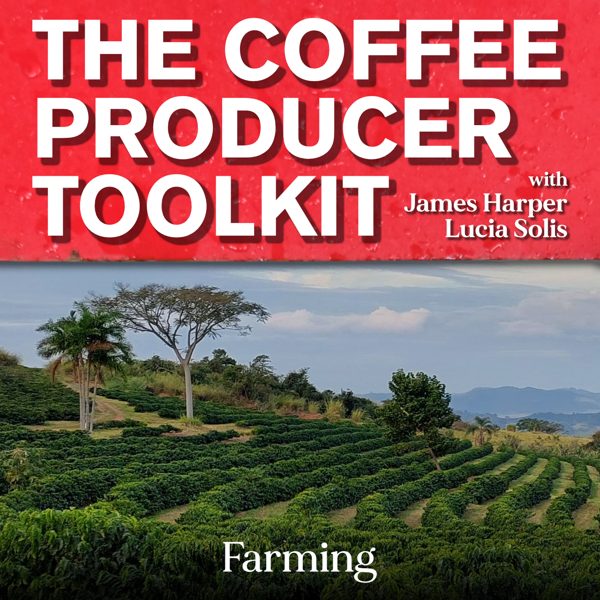
This episode explores the growing water crisis in coffee farming, why farmers are drawn to risky coffee varieties and coffee farming's hidden cashflow traps.
Part of The Coffee Producer Toolkit, a series made in collaboration with Lucia Solis, this series will help you understand coffee farming better than most professionals you'll meet at a trade show.
Each episode takes one part of the farming business — agronomy, processing, fermentation, storage, quality, sales — and lays out what the best farms are actually doing.
Stay up to date with Lucia through her newsletter
Related podcast episodes:
Lucia:
James:
People mentioned in the episode:
- Fernando Castillo Guatemala
- Paulino Quintero, Colombia
- Orlando Osoria, Colombia
- Julia Ortega, Mexico
- Sergio de la Vequia, Mexico
- Hugo Lopez, Innovakit
- Manuel Mata, Colombia
- Sam Knowlton, Soil Symbiotics
- Lalo Perez, Biofilia
Resources:
- Anacafe technical management
- Coffee Cascara Compost Guidelines (English)
- Compostaje de la pulpa/cáscara de café (Espanol)
- Netafim Drip Irrigation manual
- Innovakit: abonador (fertiliser applicator)
- Innovakit: aroplateo (tree guard for weed whacking)
- Innovakit: selector de arvenses (low-drift sprayer)
- Innovakit: canguaro (sleeves)
- World Coffee Research variety catalogue
- Recommended varieties: Centroamericano, H1, H16, Mundo Maya
- Coffee&Climate Toolbox
- Access Agriculture
- World Coffee Research Resources
- Barista Hustle’s Coffee Farm Management series
The Coffee Producer Toolkit is made possible by these leading coffee organisations:
The Coffee Quest | BWT | Descamex | InterAmerican | Pinhalense | Novonesis | GrainPro
Read the transcript
Filter Stories interlude: water
James Harper: Welcome back to Filter Stories. I'm James Harper, and here we have part two of the first episode of the Coffee Producer Toolkit, focused on coffee farming.
Like I mentioned at the beginning, farming generally is the coffee industry's biggest blind spot, and yet it is what underpins our $200 billion industry. With this series I'm trying to help you understand coffee farming better than most coffee professionals you're going to meet at a coffee trade show. And this is going to change how you see coffee for good.
We covered coffee farming metrics, and now we've got to the first most important thing that Lalo, our agronomist, recommends coffee farmers focus on — and that is water.
And look, this is crazy. The fact that we are starting an episode on agronomy with water in the coffee industry is nuts. Because for the longest time, coffee farming never had to worry about water. Coffee farming is based on seasonal rain patterns. They come predictably. The water nourishes the coffee trees, you get your harvest. End of story. But today, with climate change, that is not the case anymore. We've recently seen a spike in coffee prices driven by the fact that many Brazilian farms didn't get enough rain. Climate change has been slowly screwing up coffee farming now for over a decade. And it's only getting worse. So now, on top of all the other problems that coffee producers have to navigate, water is another one.
The obvious solution to a lack of water is irrigation. But coffee is not well placed for irrigation, because it is a low value commodity. In the wine world, irrigation is very common — but wine is a higher value product. The other thing is that irrigation in coffee is extremely expensive. In Latin America, many small-scale coffee producers earn less than $4,000 a year in take-home pay, and as you're going to hear, an irrigation system is going to cost you thousands of dollars. This is existential. Many producers just cannot afford it.
I don't know what the future here holds, but it's likely that coffee prices are going to have to increase, and that producers who continue growing coffee are going to have to have some form of irrigation installed. Now, you'd think as an industry we'd come together and acknowledge, hey, you are facing this issue with water because of us in the global north using way too many fossil fuels. But, no. Farmers are going to have to figure this out by themselves, and most won't have the money to invest in irrigation.
And as frustrating as this is, Lucia and I decided, look, we at least have to be practical. What can we say to farmers who can't afford irrigation? What can we suggest they do instead? And the cheaper solution here is shade trees. Shade helps prevent what water there is from evaporating.
This might sound really obvious, but it's actually quite novel, because it sometimes goes contrary to what many national coffee organizations have recommended to coffee farmers. For example, in Colombia, their coffee organization, the FNC, have been promoting Castillo. It's a very compact variety, a small shrubby plant, very resistant to disease, produces a lot of cherries — but it works best in full sun plantations, as in, with very little shade cover.
And look, you can understand why they promoted this particular variety. Because by boosting yields you boost incomes, and that brings more money into these very remote rural communities. The problem, though, is that these full sun plantations lose so much water to evaporation. It made sense in an era of regular rainfall patterns, but now that is changing, and it's these full sun plantations that are most exposed to changing rainfall.
And so the fact that we are suggesting planting shade trees — it might sound so obvious to us from a distance, but this advice is really going against national government coffee policy in many cases.
Okay, so with all this context now in mind, let's hear this next section on water. Pressing play.
Water
Lucia Solis: So let's start with the one that surprised most people. It actually surprised us when we were having the conversation with Lalo, and that was water.
James Harper: So, as Lalo mentioned, water is the number one driver of a farm's profitability. Lalo sees that years with insufficient rainfall are becoming more and more common. And this has a direct knock-on effect on the harvest. Coffee plants need water to arrive at the right moment to trigger flowering. If the rains don't come on cue, the flowers don't come either. And without the flowers, there's no harvest. And without a good harvest, there is no path to profitability.
Lalo Pérez: Escuchamos de años más secos, con menos lluvia, con pobres floraciones por falta de agua en los momentos óptimos. En Brasil es un tema muy común, porque está en una latitud muy sur, que es equivalente a — en México tenemos este mismo fenómeno, pero tenemos una latitud muy norte.
James Harper: The trees themselves, when there's little water — yes, they survive, but they're not thriving. There's a loss of what is technically called turgor. There's a lack of water in the plant system.
Lalo Pérez: Realmente no está urgente, aparente — o sea, ella se ve estresada. Es dificil describirlo con palabras, porque creo que todos los productores reconocen los síntomas. Pero hay poco que pueden hacer sitienen su cultivo a pleno sol.
James Harper: He mentions how many producers who work in full sun systems with no irrigation can see that their plants are looking dehydrated, and they feel like there's nothing they can do about it. All they feel they can dois pray for rain.
Lalo Pérez: Si no tienen un sistema tecnificado de riego, no hay mucho que hacer. Pues uno puede ver su planta disecada y rezar.
James Harper: Now Lucia, our producer listening to this might think to themselves, well, I guess the solution isirrigation, right? Let's add water to the plants.
Lucia Solis: And James, in many other industries, that is the way that it goes. Everybody irrigates. From my background in winemaking, almost every farm was irrigated. In fact, working in the Napa Valley, a lot of marketing was done around farms that weren't. You had to signal: we are dry farmed, we don't have irrigation. And that was something that a lot of people valued. So the standard was irrigation and the standouts were vineyards that are dry farmed. Whereas in coffee, we have the opposite, where the standard is that they are not irrigated, and it's a very few exceptional coffee farms that are.
James Harper: Very few indeed.
Lucia Solis: So we spoke to one of the few farms that has invested in an irrigation system, just to get a feel for what does it actually look like if you're trying to irrigate your farm when very few people are actually doing it around you.
Julia Ortega: Soy Julia Ortega. Me encuentro en Puebla, México, en la Sierra Norte de Puebla, en Finca Los Pinos. Es una finca organica y carbono neutral.
Lucia Solis: Julia Ortega's farm is in the Sierra Norte de Puebla. Her farm is called Finca Los Pinos. And what makes her really unique is that not only is she organic, she's actually a certified carbon neutral farm. It's a smallish farm — it's seven hectares, and she produces about 50 bags of green coffee, more or less, in a given year.
James Harper: Julia's farm, like almost every coffee farm in Mexico, runs entirely on rainfall. But three years ago, a severe cold snap hit, followed by a brutal drought. Now, her husband happens to be an irrigation specialist, and he came to her with a proposal: let's put in irrigation.
Julia Ortega: Riego. Y yo le decía, es que estás loco, o sea...
James Harper: She thought he was out of his mind. The cost of a proper irrigation system on a coffee farm — unthinkable. But he pushed back, and he made an economic argument she couldn't counter.
Julia Ortega: ¿Qué quieres? ¿Perder la cosecha y el cliente? No, pues no.
James Harper: Do you want to lose the entire harvest and all your clients? And so they installed an emergency irrigation system, and that year the farm not only survived, it thrived. The coffee went on to win a competition, and the prize money covered the cost of the investment entirely.
Julia Ortega: Y ese año nos fue muy bien, porque entró el café a una subasta, y digamos nos repusimos con eso, ¿no?
Lucia Solis: So Julia's husband, Rubén, gave us a technical breakdown.
Rubén: El sistema de riego se instaló en el 2018.
Lucia Solis: The drip irrigation system they installed ran to one thousand seven hundred dollars per hectare. Once the design is done, a couple of people can put it up within a few short days.
Rubén: No es algo complicado. Es algo que cada agricultor puede hacer con dos o tres personas más.
Lucia Solis: But the design work is a critical part. The hydraulic calculations, pump sizing, pipe diameter, water source capacity — these things really do require an expert. If you get it wrong, the system simply won't perform.
Rubén: Sí es importante que te hagas los cálculos.
Lucia Solis: To be clear, what they built at Finca Los Pinos wasn't full irrigation. Rubén calls it riego de auxilio — emergency support irrigation. So the goal isn't to water the plants constantly, which isn't necessarily what you want in a coffee farm anyway. It's specifically to protect the flowering and fruit formation during these critical dry weeks when the rain simply doesn't come. Exactly what Lalo was saying.
Rubén: Como siempre les he dicho, un riego de auxilio.
James Harper: And now, just to round this out, let's look at what it takes to irrigate a Brazilian farm. I reconnected with Marina from Fazenda Paraiso. They're a Brazilian farm that I made a Filter Stories episode about last year, where I followed their journey trying to get into the specialty coffee world.
Marina Velloso Pereira: We can see the environmental change.
James Harper: And just as Lalo described, they've been hard hit by shifting rainfall patterns. Five years ago they were producing 44 bags per hectare. Last year that number halved.
Marina Velloso Pereira: So, productivity in 2020, it was around 44 60-kilo bags per hectare. And last year, what we had is 20 bags.
James Harper: Flowers were not forming, because water was not arriving at the right time. And so they then focused on trying to irrigate parts of the farm, hoping to claw back roughly half of the harvest they'd lost. So this is not a full recovery, but just enough to soften the blow. And look, even for them it really wasn't easy.
Marina Velloso Pereira: The irrigation system is very expensive. Very expensive.
James Harper: For them, irrigation is ten thousand dollars a hectare. That's over five times more expensive than for Julia over in Mexico. And what was also really complicated is the bureaucracy — they needed permits from two separate government bodies. And actually, in the end, they were only able to irrigate six of their 25 hectares.
Marina Velloso Pereira: Which is around 60 thousand dollars.
James Harper: So, long story short, irrigation can be a very significant investment.
Lucia Solis: And it's deeply technical. But there is good news. When speaking with Lalo, he explained that there's actually a great deal you can do to help your plants get water at the right time — to trigger those all-important flowerings — without ever needing to irrigate at all. So Lalo's answer to the water problem isn't only to add more water to your farm. There's actually a lot you can do if you stop losing the water that you already have.
Lalo Pérez: Creo que la mejor manera de modular el contenido de agua en el suelo, de nuevo, es con el sistema sombra.
Lucia Solis: His preferred method for this is a shade system. The first thing that shade allows you to do is to reduce transpiration.
Lalo Pérez: Reduce la evapotranspiración que hace el cultivo.
Lucia Solis: A coffee plant growing in full sun is losing water through its tissue all day long. That's an unnecessary loss that shade can simply eliminate.
Lalo Pérez: Y es una pérdida innecesaria que podemos modular con sombra.
Lucia Solis: The second is about protecting the soil itself. At night, moisture accumulates near the surface, but the moment the morning sun hits an unshaded farm, that humidity vanishes. With shade cover, you trap it.
Lalo Pérez: En cuanto sale el sol de la mañana, toda esa humedad superficial que tenemos se pierde.
Lucia Solis: And the third is fixing the mineral composition of the soil, because that affects how deep down the roots are able to go, where there is more water.
Lalo Pérez: Una gran cosa que podemos hacer es asegurarnos que nuestras raices estan fuertes.
Lucia Solis: Coffee soils are often acidic, with excess aluminium and sometimes sodium, both of which stunt root development. By applying lime and agricultural gypsum, you can correct the acidity of the soil, and that encourages roots to push deeper, where the water is sitting further down, out of reach of the sun.
Lalo Pérez: Y también pueden tener excesos de sodio. Y puede ayudar muchisimo que la planta o el cultivo pueda conseguir el agua que si esta en el subsuelo.
Lucia Solis: And so, when you put it all together, the logic is simple. In many cases, you don't need to add more water. Just stop wasting the water your farm already has.
James Harper: Your plants getting water at the right time ensures that the flowering takes place as it should and that your harvests are strong. Get the water wrong, and your profitability falls apart.
Coming up next: choosing the right genetics.
Lalo Pérez: La genética.
Filter Stories interlude: genetics
James Harper: Pressing pause. Okay, so this next section is on plant varieties, genetics. And Lucia and I had a massive editorial challenge here, because, look, our listeners might be based in Indonesia, Honduras, Tanzania. Each of these places have very different geographies. One variety will not work in all of them. And what we didn't want to dois go through every single country saying, hey, we recommend this variety for this country. That would be a terrible listen for all involved. So instead we put all that stuff in the show notes.
And here, what we decided to focus on instead is a worrying trend that Lucia and Lalo have observed in many coffee farms: many coffee farms decide to replant their farms with very exotic varieties. When I say "exotic", I mean a variety that's just not common, that's not proven in that country. Take SL-28. In Kenya that variety is not exotic — it is very common, people know how to work it. But if you take that variety and you transplant it to, say, Nicaragua, all of a sudden it becomes exotic. Because heaven knows how it's going to perform in Nicaraguan soils.
This phenomenon of planting exotic varieties is very common. Indeed, in the specialty industry, it's promoted. Buyers want new and interesting flavours, they want to say, wow, look at this, we have an SL-28 planted in Nicaragua, look at these flavours, they're so different, it's what the market's asking for. And farmers see this. They see the success stories, they see that their neighbour planted the exotic variety and got a high price for it, and so they decide, I'm going to try it too.
But Lucia and Lalo really don't like this trend. They have seen too many cases where it doesn't work. With every new kind of variety you plant in your farm, you have no idea how it's going to do. It might thrive, it may fail. You hear stories of producers who invest all this money replanting huge chunks of their farm with these exotic varieties, and they don't work out. That is a huge loss. It pushes the business model, which is already under so much pressure, deep into the red.
And here's the other thing. Even if it does work out and they do get great flavours — well, as we explore later in the series, if a farm is not well placed to find good buyers and negotiate for higher prices, and most producers are not, then they're unlikely to receive great prices for the coffee. So it's very possible that their farm's profitability is now lower than it was, after taking this risky bet, than if they'd just stuck to the everyday varieties that they've already been using.
And so in this next section, that is the point we make.
Now, coming up, we also mention some other things that I think might be helpful for you to have some context on. That is hybrids, and the availability of coffee seeds.
Okay, touching on hybrids first. There has been a lot of really great genetic research in these last 20-odd years, and varieties have come out which perform super well agronomically and very well in the cup. You'll hear these referred to in the next section as hybrid varieties, and Lucia and I make a case for recommending hybrids. But let me quickly explain here what a hybrid is. Let's say you have two very different varieties of coffee — one which performs fantastically in the soil, it's very robust, and another that produces a fantastic flavour. But perhaps those two varieties are genetically very different from one another. Using very fancy breeding techniques, what you can do is create a new variety which takes the best of both of these plants. And you might have even tried this coffee yourself — a recent famous hybrid variety is the Centroamericano.
But I also want to make something very clear here. You might think that, hey, look, we have hybrids, we are doing lots of great work when it comes to coffee genetics. That is actually not the case. Relative to other industries, coffee doesn't invest nearly enough in genetic research. I made an episode about this in my science series, on coffee genetics, where I explained why, as an industry, it's so difficult to do coffee genetics. Link in the show notes.
Now, the second piece of context I want to offer is: it's actually really hard to physically move coffee seeds around the world. Take the example of hybrids. Cool, we have a Centroamericano. Could every farmer in the world use this fancy new Centroamericano hybrid? And the answer is no. With these specific hybrids, you actually need this entire infrastructure behind them. You need the parent plants, which have to be well maintained in a gene bank. Then you need labs where the plants are actually cloned, and then nurseries to grow them out. And that pipeline exists in Central America, but to have these plants accessible anywhere else in the world you have to build out this pipeline. And no one's done it yet. So that's why Lucia and I can't recommend, for example, Centroamericano for everybody. Not that we'd want to anyway, because Centroamericano may not work in many parts of the world.
And if you wanted to move a more generic coffee variety across borders — a very established variety that you don't need a fancy lab for, like an SL-28 — well, you can't, because it is illegal. Or at the very least, incredibly bureaucratic and unlikely to work. It'sa huge complicated topic unto itself. It kind of comes from the fact that places like Kenya, for example, they have the really famous Scott Laboratories where, a hundred-odd years ago, they developed the SL varieties that produce beautiful flavours in the cup. But Kenya's like, this variety is what gives Kenyan coffee a competitive edge on the global marketplace. We're not just about to give it to anybody who asks for it. That's why it's often illegal to export these sorts of varieties. And why what you'll often see is farmers just Ramboing it, right? They might travel to Kenya, take some seeds, slip them into a suitcase, take them back to another part of the world, and then plant them. It's not legal, but it's very common.
So that is why Lucia and I just aren't able to give very specific advice regarding genetics. And we really focus on the headline problem: don't chase shiny exotic varieties. We've seen too many cases where they backfire.
All right. And now let's press play.
Genetics
James Harper: Okay, so now let's explore genetics. When it comes to having a profitable coffee farm, choosing the right variety of tree is extremely important. And Lucia, I know you have some very strong opinions on this.
Lucia Solis: I do have very strong feelings about this. Because I hear this conversation a lot in the regions that I work with, especially in Latin America and in Colombia. I lived in a region in Santuario where some of the producers started planting exotic varieties. They started planting Geishas and Wush Wush and Eugenioides, kind of looking on Instagram to see what was the latest cool variety and trying to get some seeds, smuggle some seeds in a suitcase and plant those in their farm. But it's one of the biggest traps that I see in specialty coffee right now for farmers.
James Harper: Right. And now here is the story of a farmer who fell into exactly that trap. When I was down in Huila, in the south of Colombia, I was visiting producers who work with our partner sponsor for this series, The Coffee Quest. And one of the farmers I met was Paulino Quintero.
Paulino Quintero: Bueno, mi nombre es Paulino Quintero. Vivo en la finca Las Brisas, municipio de Santa María, Huila, vereda San Miguel.
James Harper: Paulino grew the conventional Colombian Caturra and Castillo coffee varieties. But at some point his Caturra trees were struggling with leaf rust, and he wanted to shake things up.
Paulino Quintero: Y le sembré un exótico. Le sembré un Pacamara.
James Harper: He'd seen his neighbouring producers selling an exotic variety to The Coffee Quest. It had worked really well for them, and he wanted in. So he got hold of some seeds, planted a small lot, and the trees looked beautiful. Fantastic foliage, strong, healthy.
Paulino Quintero: Muy bonito el arbol. Follaje, hoja, todo.
James Harper: But when the harvest came, there were very few cherries. The trees gave him almost nothing.
Paulino Quintero: Pero lo importante era que cargara, y no cargo. Pues gracias a Dios fue poquito. Era poco el lote.
James Harper: He was lucky that the lot had been small. In fact, the Coffee Quest team would never have advised him to replant his entire farm with an exotic variety. Their guidance was always to try a small lot first, see if it works, and then scale up. And in this case, it didn't work.
Lucia Solis: So that caution saved him. But had he gone all in, the consequences would have been really severe.
James Harper: Lalo refers to exotic varieties as dangerous.
Lalo Pérez: Lo creo — voy a decir una palabra pesada, pero creo que adecuada: peligroso.
James Harper: Chasing exotic varieties, he says, is dangerous because you're putting the financial health of your farm at risk based on a promise, a hope. The exotic varieties can be demanding, unforgiving to grow. And even if you manage to replicate the quality of your neighbour — you know, the one who gets the higher price — that doesn't mean that you'll get their price. There are many things that stand in between you producing a high quality coffee and getting a high price for that coffee.
Lalo Pérez: Y de la calidad al precio hay mucho intangible de por medio.
Lucia Solis: Yeah, and I want to make sure that this lands, because it's kind of counterintuitive given the direction that specialty coffee marketing has gone. They see there's a demand for these varieties, and so farmers think, well, I should plant those varieties. But I think the part that's missing is that an exotic variety alone does not guarantee a premium price. You need to have market access. You need to make sure that you can sell that to the right buyer, have that relationship. A lot of these varieties might need different processing — so the same thing that you did for your Caturra may not be the same thing that you need to do for your Geisha. And also timing in the market: from the moment that you see a trend to the time when you can harvest that fruit could be years. And a lot of these trends are kind of over in months. The agronomic cycle is much slower than the Instagram trends. And so betting your farm's future on replanting some of these exotic varieties is really a high risk strategy.
James Harper: And that's why, when it comes to genetics, Lalo's advice is to choose varieties for their robustness and their yield, and not for their promise of an exotic cup profile.
Lalo Pérez: Han sido seleccionadas por su robustez agronómica, no por su promesa en taza.
James Harper: Varieties like Sarchimor and Catimor — they're resistant to disease, they're high-yielding. Not glamorous, but grown well and processed well, Lalo says he's seen them score 87, 88, 89 points. The genetics don't have to be exciting. They have to be reliable.
Lalo Pérez: Puede catar cafés de 87, 88, 89 puntos con buen manejo.
Lucia Solis: There are two issues. One issue is, I think a lot of farmers have been told that certain varieties have like a ceiling of quality — and if you wanted to get that higher ceiling and reach that new market for specialty, you had to plant a different exotic variety, you had to plant a Eugenioides or a Wush Wush or a Laurina. And I have personally seen that that's not true. I think that a well-grown, maybe quote-unquote boring or traditional variety will outperform a new exotic trendy variety that someone doesn't know how to manage yet.
But another thing that Lalo shares with us is that we may even be wrong about that quality ceiling, because there's another category of hybrids.
James Harper: Lalo mentions that we're living through a remarkable moment in coffee.
Lalo Pérez: Ahorita estamos en un momento único y bello en el café, en donde estan empezando a salir las nuevas variedades.
James Harper: Because hybrid varieties are beginning to emerge that offer the best of both worlds: the robustness you need, but also the quality the market's asking for. He's really enthusiastic about the new hybrids like H1, Centroamericano, and H16, Mundo Maya.
Lalo Pérez: Pero realmente son variedades impresionantes.
Lucia Solis: Yeah, I'm a big fan of hybrids. That's the coffee that I produce on the farm where I live and work in Guatemala. We do Centroamericano and HI as the core of our offering. And so I have seen firsthand that you don't have to sacrifice yield for disease resistance, and you don't have to sacrifice cup quality for yield. So I think that there's a lot of promise in these varieties, especially with processing, as we'll get into in future episodes.
James Harper: Yes, but many of our listeners will have farms in many different parts of the world, and they may not have easy access to those specific hybrid varieties.
Lucia Solis: So World Coffee Research has a fantastic webpage where you can examine different varieties for your farm and see what hybrids are available for where you are.
James Harper: So, to close out this section on genetics: don't chase exotic varieties. They're risky, as Paulino Quintero found out. Focus instead on tried-and-tested conventional varieties, and the new generation of hybrids that are beginning to emerge. Choose yield and resilience as your primary criteria. And if you grow them carefully and process them well, quality and profitability will follow.
And just to finish on Paulino's story: after his Pacamara experiment didn't pan out, he chose instead a tried and tested variety.
Paulino Quintero: En ese lote volvi a sembrar un Caturra Chiroso.
James Harper: Chiroso — which, despite the name, isn't actually a Caturra. It's another exotic variety. But unlike the Pacamara, it has a better track record, because it's been proven in another Colombian coffee region, Antioquia, for over 30 years. And now in Huila, he's relieved to see the trees are producing a good harvest.
Paulino Quintero: Pero está muy bonito y muy bueno. Y ya con la primera cosecha se vio que sí es rentable.
Filter Stories interlude: replanting
James Harper: Okay, pressing pause. In this next section we talk about how to renovate, how to replant your farm. And the message is really: go slow. Don't take on external capital. Don't take on debt to do it.
And we decided to include this because Lucia and I have seen too many cases where a coffee producer rushes into coffee farming. They have a huge desire to do it really well. They plant maybe a lot of coffee at once. But then later on, they fall into a trap. A cash flow trap.
For example, one of my first Filter Stories episodes focused on the case of Murray Cooper. He was a South African who was in Ecuador, starting a coffee farm. He bought what had been a cattle farm, and then planted a dozen or so hectares with coffee. Now, planting the coffee in the first place didn't require that much cash — he had more than enough. But the problems started mounting three plus years later, when the harvest started coming in. All of a sudden, he needed cash. A lot of it. Five thousand dollars a week to pay for the coffee harvesting. And he didn't have the cash on hand.
Now, of course, he could have got a bank loan. But the interest rates are eye-wateringly high by global north standards. If a producer is lucky, it's 10%; it could easily be 30% and more. And in his specific case, he didn't have much of a credit history, and so he couldn't even get access to a loan. The story has a sad ending, because Murray ran out of cash and he had to sell the farm.
Now here's something really unfair and crazy about the way coffee is bought and sold. After a producer has sold their coffee, and it's been shipped off their farm, it can still take months and months and months before they actually get cash in their hand, before they actually get paid. Because if a coffee farmer sells to an exporter, that exporter then has to sell to an importer, and that importer may not pay the exporter until that container of coffee has landed in the importing country. And so some exporters have terms where they're like, we're not going to pay you, farmer, until your coffee has been delivered.
And these last few years it's been getting even worse. The green coffee business is quite concentrated. It's like an oligopoly. There are only a couple of really big trading firms, with lots of different sub-brands. And there have been instances of these very large groups trying to improve their own financial situation by pushing out their payments. So instead of paying sooner, they pay much later. It's great for them, because they have access to more cash. But that has a knock-on effect down the supply chain. Exporters get paid later, which means they have to pay their farmers even later. And I find this a really ugly part of the industry, because farmers — the people in the supply chain who are least able to shoulder financial burden — are being asked, demanded, to share that burden for the benefit of major coffee corporations.
Anyway. So farmers who have been in business for a long time, they Know about this cash issue and they have found ways to cope. But newer farmers don't see this yet, and some fall into this cash trap. Which is why Lucia and I have just one big lesson we wanted to get across: go slow. Don't do what Murray Cooper did back in Ecuador, where he grew too fast and he ran out of cash too quickly. If Murray had gone slower, he'd still be in business today.
Okay. Pressing play.
Replanting
Lucia Solis: James, in this series we've spoken to a lot of producers, and there's a trap we keep coming across, one that catches out a lot of farmers, and it has to do with how you go about replanting your farm. We've heard stories of producers getting the timing and the approach badly wrong, in ways that seriously cripple their business.
So we want to share a simple rule of thumb. When you're thinking about renovating your farm, ask yourself whether you can do it without taking on debt, without reaching for external capital. Because debt is expensive, and it's dangerous: if the harvest doesn't come in the way you hoped, you are financially exposed. If there is a way to renovate your farm without taking on external capital, without taking on debt, we suggest that you strongly consider that path.
James Harper: And here we want to share a story that kind of hammers this point home. So going back to Fernando, from the top of the episode, the Guatemalan producer. He recognized that his farm had to compete with Brazil. The farm was under-managed, underperforming.
Fernando Castillo: En mi mentalidad, quería resembrar, tener ordenado, saber en dónde están las plantas, tener mis conteos de plantas exactos.
James Harper: He has an engineering background, and his instinct is to do things properly: just rip out all the old trees, replant the entire farm, start from scratch with everything in the right place.
Fernando Castillo: Resembrar sí representa una inversión considerable.
James Harper: But his approach required serious capital — around two dollars per plant, and that's across tens of thousands of plants, plus the cost of labour, which is becoming increasingly hard to find across Central America. He was lucky that the wider family business could fund the replanting, so he didn't have to take on debt. But looking back, he still regrets this approach.
Fernando Castillo: Yo no entendí los beneficios económicos que eso podía traer, porque requería mucho menos inversión — más bien, no requería inversión.
James Harper: Because so much of his farm, even in its under-managed state, was still producing cherries, still generating cash. Looking back, Fernando thinks he should have followed the advice of Guatemala's national coffee association, Anacafé. Instead of replanting everything, they advocate for boosting the yield of existing trees through structured pruning — what's known as tissue management — paired with better nutrition, pest management, and weed and shade management. Those are relatively cheap fixes that lift yields and generate even more cash, which would then have funded the gradual renovation of his farm. And so, actually, paradoxically, he could have reached profitability faster by renovating his farm incrementally and not all at once.
Fernando Castillo: Digamos que manteniendo las prácticas que llevábamos, podía mantener la operación y ser rentables más rápido.
James Harper: Go slow. Use the trees you already have for cash. Change your farm incrementally. That will get you to profitability with less risk, and maybe even faster than bringing in external money.
Lucia Solis: You know, James, this seems, again, like too basic information — to go slow and to not take big risks. It's a very logical approach, and it makes sense. But I think what we have to remember is a lot of these farms and a lot of coffee is not logical. And you can see how people can get really excited about a new project and just have all of that energy and go forward and want to make a big change. So I think that it's important to remember how really smart people can really easily fall into these common traps, these common mistakes.
So growers: feel free to take your time. Eventually you'll produce the farm of your dreams. But for it to survive financially, you need to minimize the amount of risk you're taking. So just go slow. You'll get there eventually.
James Harper: Lucia, coming up next, we now get into the world of plant nutrition.
James Harper: Pressing pause on the episode. Coming up in the rest of the original episode, we cover plant nutrition, cherry pulp fertilizer, and labour and tools. It's a lot to cover. So let's just take a break now, and I'll see you in the next episode.
Listen on Apple Podcasts, Spotify, Pocket Casts or your favourite app.
More from The Coffee Producer Toolkit
See allFarming, Pt 1 — Low harvests and profit blind spots
This series will help you understand coffee farming better than most professionals you'll meet at a trade show.