Show notes
Martin is the best barista in Kenya and has a dream to open a cafe. Except, he can't. Kenyans don't drink coffee.
But he has a plan: he’s going to win the World Barista Championships to change coffee drinking culture in Kenya forever.
But, he's all alone and up against the richest barista teams in the world. Can he do it?
Follow on Instagram: https://www.instagram.com/filterstoriespodcast/
Episode transcript: https://medium.com/@FilterStories
Piano music composed and performed by James Harper
Sound mixing: Dom Edgley / https://domedgleysound.com/
Filter Stories logo: https://headquarters.studio/
Read the transcript
James Host: I helped stage manage the World Barista Championships for a couple of years. They’re a big deal in the specialty coffee world. Think of them like coffee’s formula one. There’s big money being thrown around… rich teams from rich countries spend up to hundreds of thousands of dollars and in 2015 a guy called Martin Shabaya shows up to the World Barista Championships. He wasn’t a part of the big, rich teams. In fact, he doesn’t have a team at all. He is all alone. and not only that. It’s the first time he’s ever travelled outside of his own country. Martin is Kenya’s best barista and he’s here in Seattle in 2015 to represent Kenya on the world stage.
[Stephen Intro WBC Seattle] Welcome ladies and gentlemen to the 2015 World Barista Championship.
James Host: Now it goes without saying that the odds are stacked him. I mean, there are many baristas from poorer countries that turn up every year to these championships and they all do quite badly. But what amazes me about Martin’s story is his ambition. He isn’t just trying to win a coffee competition with the odds totally stacked against him. He is trying to solve a national problem. Martin wants to convince Kenyans to drink Kenyan coffee.
[Intro WBC Seattle] Alright everybody, big round of applause for our second competitor of the week everybody, Martin Shabaya representing Kenya.
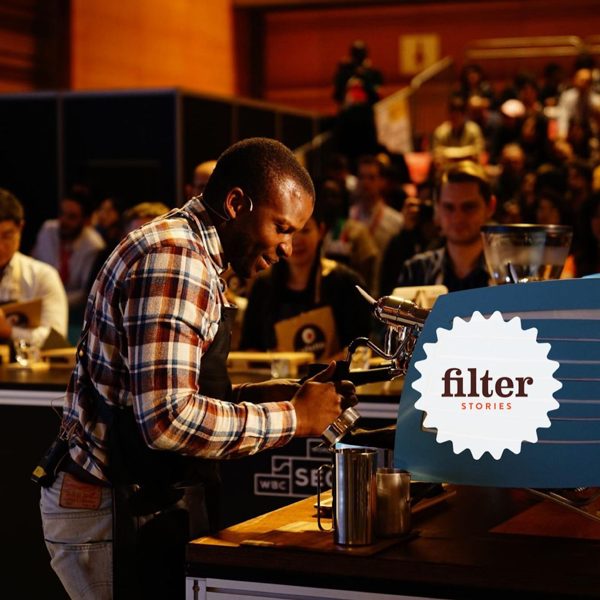
James Host: Martin’s wearing a crisp white shirt and a tie, sleeves rolled up above the elbows and right now he’s walking on stage to perform in the first round.
[Intro to Martin getting ready for performance]. So, Martin whenever you are ready.
Martin: Music, please start. [music starts]
James Host: You’d think listening to the smooth jazz music that Martin’s performance in Seattle is going well.
Martin: Now, we know in natural process that the beans are…
James Host: You’d be wrong. It’s going very badly. Martin is in front of a panel of judges and he has 15 minutes to present four espressos, four cappuccinos and four creative drinks but the majority of the points come down the espresso and that’s what Martin is screwing up right now. I hop on Skype with Martin to hear what went wrong.
Martin: It was one of the first coffees that I had selected here, and it was certainly not here but on the other side, no crema. I tried with the grind size texture amount, no crema [Martin laughs].
James Host: Crema is that rich brown foam that floats on top of an espresso and Martin wasn’t getting crema because he didn’t pack and seal his espresso beans properly before he took them on the plane. When he got to Seattle, he had to serve espresso coffee that had been exposed to too much air — and it just doesn’t taste good.
Martin: I believe that I am standing here as a source of inspiration to all of us who are so passionate about barista as a profession. It’s my time.
[Martin WBC performance] Round of applause everyone for the barista champion from Kenya Martin Shabaya!
James Host: Martin finishes up and out of 49 competitors, he comes 43rd.
[Somber music starts]
And, quite frankly, this is what everybody expects. A competitor from Africa tries to win at these championships every year, and every year no one progresses into the next round. and do you know what the worst part is, it seems that nobody cares. But why is that? Kenya grows some of the most interesting and complex coffees in the world. For example, I ask Martin over Skype what his Kenyan coffee tasted like.
Martin: The flavors were blueberry, blackberry, lemon.
James: This coffee competition has been going on for 15 years and why it is that Martin and other competitors from Africa who grow great coffee year after year fail to get past the first round of a coffee competition? I ask Martin why.
Martin: I just spoke with other baristas who I was competing with and [04:13 inaudible] really, really a lot of money to reach wherever they are and here in Kenya no, it’s not to that level where I can spend how many thousand dollars to go work on the tip of the tap or the glasses.
James: Like in most sports, the more money you throw at it, the better your result. With the odds staked against him, I ask Martin why he bothers to compete at all.
Martin: Competition has given me everything. Many people have gotten to know more about me, so I think by that, that’s a very good head start.
James: A head start for what? I ask Martin what his plans are?
Martin: I have a lot. It’s huge and it’s getting brighter. I really want to own something like a coffee shop or try to shed a bit of light on this industry.
James: Martin could have chosen a different dream. He’s going to struggle to open a café in Kenya. At its heart, Martin’s got to solve a riddle. Kenyans don’t drink coffee.
Martin: A very small percentage of Kenyans have Kenyan coffees but mostly because Kenyan coffee to us is expensive. Ordinary Kenyans cannot afford a dollar or less for tea. But coffee is mostly the cheapest to the dollar.
James: Imagine if you earned $1 an hour, the average Kenyan wage and a shot of espresso cost you $2. Would you work for two hours for a single shot of espresso?
[music starts]
James: But maybe Martin’s on to something with these competitions. Could you say that some from Kenya are doing very well at the World Barista Championships where people switch from tea to coffee?
Martin: It will capture a lot of people actually because myself, I really turned a lot of my friends. But if we are on the world stage and then it’s being advertised well and then people will want to know where can I get this award winning coffee.
James: So, you’re saying, if you can do well at the World Barista Championships, then you have a much easier time opening a café in Kenya?
Martin: Yea, that’s exactly right.
James Host: Can Martin do it and become the first African competitor to ever make it past the first round of the World Barista Championships?
[Slight pause, dramatic music]
James Host: I am James Harper, and this is Filter Stories. The untold stories hidden in your cup of coffee.
The year is now 2016 and Martin is back in Kenya working hard to improve his performance routine.
James: How did you change? What did you learn and how did you grow in that period?
Martin: When I was in Seattle I was so green. I had very good judges who really wanted to help me. I learnt a lot about what is important in terms of explaining or presenting what the judges are really looking at.
James Host: So, when the time came to compete in the Kenyan 2016 National competitions, he actually goes over time by 19 seconds, but despite that, he still comes first and now people are starting to notice him. He’s getting more serious attention from big TV networks, such as the BBC and CGTN Africa.
TV clip: He’s Africa’s top barista.
James Host: And France 24
TV clip: Now, the two time Kenyan champion Martin Shabaya is preparing to compete at the World Barista Championships. Now, caffeine culture is starting to filter back to East Africa and at cafes opening across Kenya’s capital Nairobi consumers are proud to drink local.
James Host: This is exactly the kind of attention Martin needs if he wants to open his café and now it’s on him to keep this momentum going and do better than he did in Seattle.
[music plays]
So, in 2016, he hops on a flight to compete in the 2016 World Barista Championships in Dublin, Ireland. His employer is singing Martin’s potential and this year he is joined backstage by a few people from the company. But he still needs to find a solution to transporting his roasted coffee from Kenya. Remember in Seattle he lost points because he didn’t pack and seal his coffee properly. More experienced competitors would have found a way to pack and seal the coffee appropriately for the journey. But Martin was so scarred by his experience in Seattle, that this time round he does something quite radical.
Martin: I learned from that and this time round I decided to go with green beans in Dublin. [Martin laughs].
James Host: Martin’s taking coffee that’s not roasted at all. So, instead of brown beans, they’re green beans and just to be clear — you cannot make espresso coffee without first roasting the beans. It’s like eating pasta before it’s cooked. Now, if you’re an experienced competitor listening to this story right now, you’re probably very worried for Martin because you know that how you roast your coffee will impact its flavor dramatically. Each batch of roasted coffee will taste just a little bit different. but at this level, these differences might make the difference between getting to the finals or not.
Now, to give you an idea of what Martin should be doing, I interview the US National Barista Champion Kyle Ramage.
James: How are you feeling Kyle?
Kyle: Pretty good. Pretty nice. Yea.
James: So, what are you doing exactly?
Kyle: When you make coffee at this kind of nerd level 1000…
James Host: Kyle points to a table of 22 tubes of the same coffee, all roasted slightly differently. Kyle roasted these coffees over 10 days ago, well before he set foot on a plane. and each tube has subtle, but important differences in flavor.
Kyle: We’ve put a year worth’s time of practicing and thousands and thousands of dollars into coming here so it all comes down to two of these tubes. Going onstage…
James Host: So, this is Martin’s situation. He’s in Dublin with 1 kilo of amazing Kenyan coffee that’s not been roasted, and he needs to find a roaster, a good one. If the roaster screws it up, Martin is going to fail at these competitions again and his dreams of opening a coffee shop in Kenya will be further away than ever.
Martin: Yea. So, what I knew actually was obviously in Dublin there are some coffee shops around. Obviously if I would walk inside there and told them I had green beans I need someone to roast for me I hoped that someone would help me.
James Host: So, that’s his plan. He is just going to find a coffee shop in Dublin and ask where he can roast his coffee. But, what if they don’t have any time to help him. What if they don’t know how to roast this particular type of coffee and they screw it all up?
Martin: So, I just walked out from the hotel room one morning then bumped into this guy called Brian.
Brian: Brian speaking. Hey James. How are you?
Martin: and then he runs a very small coffee shop. It’s called Silvers Cube. I just asked that guy if he knows someone or somewhere where I can roast green coffee.
Brian: and Martin did ask the question do you know where I can roast coffee and I said no, you can’t roast it here because I am really busy and there’s a big queue of people here and it wasn’t until he told me that he had brought the coffee with him to compete in the World Barista Championship. I actually asked Martin that question. Did you just bring your competition coffee and hope to walk up somewhere and get somebody to roast it and he said yes and then I said well, I am definitely the right person. I will roast it. So, I just said to Martin I’ll take your number and you take mine. We’ll exchange numbers and I’ll meet you at the roastery later.
James Host: I asked Brian what he thinks of Martin’s coffee from Kenya.
Brian: It was Kenyan coffee so immediately I knew it was going to be good. It was really green/blue color and Martin was bringing it with him and guarding it like it was his child. So, I knew straight away the coffee was good.
James: So, back up a second. So, Martin only had a kilo of coffee?
Brian: He had such a small batch of it.
James: And you basically had one shot at this, to roast in a 15 kilo roaster.
Brian: The recommended batch, three kilos is the smallest, so we really took a chance to not set it on fire or completely mess it up.
James: The fate of Martin’s performance and scoring is sitting in your hands as a roaster. What’s going through your mind at this point?
Brian: I just said to Martin. Do you want to do this? Are you comfortable enough with us just going for this? And his answer was yes why not? Let’s do it.
James: But the story doesn’t end there.
Brain: I think Martin expected me to roast his coffee and then leave. But I wouldn’t let him!
Martin: And he took me around. I don’t know what made me but go to those bars but there are traditional bars and traditional songs that they do in Dublin.
Brian: I just thought the perfect end would be to go to the pub. He’s in Ireland. Why let ourselves down?
Martin: So, he took me there. We had some good times but unfortunately I don’t drink so I had just had my tonic water. They really cherish their local beer.
Brain: You want to verify that with him, but I think I was buying him pints of Guinness and I think after three beers Martin told me he was a teetotaler and he doesn’t drink. I’m almost sure that happened, yes!
Announcer: Representing Kenya Martin Shabaya.
James Host: So, Martin is now on stage for the second time in his life at the 2016 World Barista Championships.
Martin: I am just about to serve you a very special coffee. It’s of the French mission bourbon variety.
James Host: His performance is going really well. It’s a lot better than last year.
Martin: This coffee was first introduced in Kenya in the year 1896.
[Sounds of machine falling apart]
James Host: Until that happens. Martin has a juicing machine on stage where you squash fruit by turning a crank. But the bit that holds the fruit in place suddenly flies off! Did you hear it? I’ll play it again.
[Juicer breaking]
That is the sound of Martin’s hopes of getting into the next round literally falling to pieces. Juice is now everywhere, and he’s being thrown off his game. There’s a cruel irony here. Remember those two workmates who came with Martin to help him backstage.
Martin: From the two who are assisting me in the polish backstage, whoever was wiping it didn’t return it to the way it was supposed to be.
James Host: Martin forgot to check his equipment was put together properly after his colleagues polished it for him, but Martin continues onwards.
Martin: Because I knew I had lost everything. So, I had to gather all the other marks that I could and that’s where my confidence and my courage comes up. I had the best time.
Announcer: Time.
[audience claps]
James Host: Martin finishes up his performance and by all accounts, the espresso comes out okay. When all is said and done, Martin comes 24th in the world in 2016. Now, that’s a huge leap compared to last year, where he came 43rd. But that’s still a long way from the top 16 who are getting into the next round. But to really make a splash in Kenya, he has to do better and to do better, he needs to learn the subtle things judges look for when scoring his performance.
Martin: Okay, what I learned in Dublin was connecting flavors from my beginning of speech to the end of it.
James Host: By the time the 2017 Kenyan National competitions roll around, Martin knows better than anyone what the judges are looking for and of course, he wins. Now’s he’s off for his biggest test ever. Martin’s now going to represent Kenya for the third time in a row at the 2017 World Barista Championships taking place in South Korea.
Announcer: Welcome ladies and gentlemen to the 2017 World Barista Championships.
James Host: This is Martin’s chance to make the biggest splash ever. It would be perfect if he could make an impression on someone closely connected to the Kenyan president. Imagine how many Kenyans would begin to drink coffee if the government began promoting it more heavily?
Backstage, Martin makes fast friends with Mario Idrovo, the Ecuadorian barista champion.
Mario: We trained with him and he told us ‘Mario, this is my third year and I can’t go home if I don’t go to the semi-finals’.
James: But Martin is only half joking. The reality is Martin may have to leave Kenya if he fails this year. Former Kenyan barista champions have opened up cafes — but it’s taken them well over a decade to find the money. Many of them choose to emigrate. Many of them end up in Dubai.
Martin: They are all there.
James Host: And this is going to be an issue because Martin has some really exciting news to tell me before he gets on stage in Seoul.
Martin: Yeah but after this I have something big before me. I am having a wedding next weekend.
James: You have a wedding?
Martin: Aha!
James: Your wedding?
Martin: My wedding.
James: You are getting married next weekend?
Martin: Yeah.
James: Oh my God!
James Host: And in Kenya marriage means children.
James: Do you have plans to become a father soon?
Martin: Of course. That’s the first thing actually from our community.
James Host: Martin will soon be facing some life choices that many of us in the west have never faced. If Martin can’t convince more Kenyans top drink coffee he might need to move to Dubai to earn the money he needs to open his dream café. But what about his wife and children? How practical is it to bring your entire family?
James: How would it make you feel if you had children in Kenya, but you were living outside of Kenya?
Martin: I wouldn’t allow that [Martin laughs].
James: If you did move to Dubai would your wife come with you?
Martin: I would love to… but moving now to Dubai means that I would have to come alone… maybe start a family over there.
James: Could she not come with you?
Martin: No, she can come but you think it’s easy? I think the expense would be fairer if she just remained at home and me going alone. It’s very complicated.
Announcer 1: Are you ready? Let’s kick this off one more round of applause. Please…
Announcer 2: Give him a hand please!
James Host: Martin walks onstage to begin his performance.
Announcer 1: When you are ready go ahead and raise your time. Raise your hand….
James Host: This time round, Martin found some green beans in Kenya and roasted them in Kenya as well and he packed and sealed them appropriately for the journey.
Martin: Alright, so I’m excited to serve your first course which is the espresso. Now this coffee has three distinctive flavors that is blackberry, lemon and hints of blackcurrent.
James Host: But for all Martin has grown as a competitor, getting into the semis is going to be a long shot. Martin’s been trying to win these competitions all by himself. The rules are complex and ever-changing. What Martin really needs is a professional coach, but I hear the going rate these days is $2000 a day, maybe more. Martin doesn’t have that kind of money.
Martin: I would just like to say thank you very much. Time. [audience claps]
James Host: Martin finishes up his routine. He has come across smooth and professional. It’s been a world class performance and because he performed earlier in the day the live rankings show that he is in the top 15. He can make it into the semis. If he can just hang in there he’s going to make it into the semis. Here is Mario from Ecuador.
Mario: And you know what’s funny, I was with Martin downstairs and then he was telling me to constantly check my phone and then we were looking at that and then I’m like Martin, I have bad news and then I was like I’m so sorry Martin, I’m so sorry.
James Host: Martin comes twenty-second overall. That’s well outside the top 15 who are going through automatically. But then the most incredible thing happens.
[Announcer speaking]
There is a wild card slot for the sixteenth place and Martin gets it and he is going through into the next round! I race backstage to find him.
James: Jambo, how are you man?
Martin: Very well! [speaking Swahili] I really can’t explain but this is something that has never happened.
James: Did you hear how loud the cheer was for you.
Martin: I don’t know man. I was really confused actually until now. I am going to take back the coffee that I gave out, all of it.
James: You gave out your coffee! Why?
James Host: Martin gave out his amazing Kenyan coffee to his new friends because he wasn’t expecting to get through.
James: So, you didn’t think you were going to get this far so you gave away your…
James Host: Will Martin find his beans in time for the semi-finals.
Announcer: A big round of applause for the barista champion of Kenya, Martin Shabaya.
James Host: By the next day Martin has found all his beans again and now he is on stage making history as the first African competitor to make it into the semi-finals.
Martin: Alright allow me to connect you in advance with this drink of my own creation.
James Host: The stands are packed full of support for him and you can see, he is beaming with pride. So, I am in the stands watching the performance and on my right I overhear some news from a well know coffee professional working in Kenya.
Kenyan professional: So, the grandson of the very first Kenyan president is just watching this.
James: Really?
Kenyan professional: Yeah. Yeah. Yeah.
James: Wow. Oh, my goodness! What was his reaction?
Kenyan professional: I just saw he was watching it. [laughs] I’ll talk to him next week.
Martin: … to me. That’s my time.
[audience claps and cheers]
Commentator: Very impressive. I’ve always been impressed by Martin.
James Host: As soon as Martin finishes his performance I race over to tell him that the son of the president, who also happens to be the grandson of Kenya’s first president was watching…
James: [speaks to Martin] Kenyatta was watching.
Martin: No! Really! How?
James: On the livestream.
Martin: The grandson!? That’s an honor, a big one. I didn’t know they know anything about barista. Thank you. Thank you so much.
James Host: At the end of the day Martin doesn’t progress into the finals this time. Just six competitors get selected and they are the usual suspects, all the rich countries. But what matters here is how Kenyans reacted to Martin’s win.
[music playing in background]
I asked him what kind of reception he got when he landed back in Nairobi.
Martin: Amazing. Here in Kenya it’s like I won WBC 2017.
James Host: It’s still early days for Kenya’s café scene and Martin’s dream of owning a café but the momentum is growing. One day in the future Kenyans will wake up to syrupy sweet coffees with aromas of berries grown from their own soil. They may even drink this coffee at Martins own café, and it will feel like the world has got a little bit fairer. The French will love their French wine, the Germans will love their German beer and finally Kenyans will love their amazing Kenyan coffee.
Martin: I can’t wait for the day when my country Kenya will get to enjoy and love their own amazing coffees.
[music plays]
Credits
James Host: Thank you for listening to episode three of Filter Stories. This is an updated version of the pilot episode that kickstarted Filter Stories in early 2018.
If you like the show, subscribe on your podcast app so you won’t miss future episodes and updates.
This is second last episode of the 2018 mini-release. Please keep telling your friends about Filter Stories so I can bring more compelling stories in 2019.
The distinctive Filter Stories logo was created by Headquarters, a branding and packaging design team. Do you plan to roast coffee and need design inspiration? Check out Headquarters other amazing work on their website: www.headquarters.studio.
This episode was impeccably mixed by Dom Edgley, a Berlin based sound professional. If you need an audio guy, visit https://domedgleysound.com/.Links at Filterstories.org.
If you share Martin’s dream of opening a coffee shop (and you’re lucky to live in a neighborhood that actually drinks coffee!), check out the Keys to the Shop podcast by Chris Deferio. His podcast is a treasure trove of practical information.
People I’d like to thank for the episode: Martin Shabaya, World Coffee Events for the performance audio, Mario Idrovo, Steven Vick, Kyle Ramage and Lem Butler of Black & White Coffee Roasters in North Carolina and Brian Kenny of Silverskin Roasters in Dublin.
Editorial feedback: Andrew Johnson, the inventor of the CupOMatic app — the tool that every coffee professional needs to keep their cupping on track, Vasant Chari, Ed Maine, Kyle O’Neil of Episode 1 Café in Leeds, UK. and the many, many other people who gave their feedback on the pilot episode. You know who you are!
I produced, edited and wrote and performed the piano music for Filter Stories.
Follow Filter Stories on Instagram @filterstoriespodcast and visit filterstories.org to sign up to the newsletter. In the newsletter I include recommendations to other gripping documentary podcasts and fascinating articles for you to read.
Until next time.
[musical outro]
Listen on Apple Podcasts, Spotify, Pocket Casts or your favourite app.